You are currently viewing Traveling on Renfe Trains With a Dog in Spain: New 40 kg Rules Explained

Traveling on Renfe Trains With a Dog in Spain: New 40 kg Rules Explained

Great news for dog parents planning a pet-friendly trip to Spain! The rules for dogs on Renfe trains have changed, making rail travel around Spain much easier – especially if your travel companion is too big for a carrier. Renfe, Spain’s main rail operator, now allows dogs weighing up to 40 kg to travel without a carrier on eligible AVE, Avlo, Long Distance, Avant and Media Distancia services. Small dogs and other permitted pets weighing up to 10 kg can still travel inside a carrier, so the small dogs option has not disappeared.
 
For travelers planning a multi-city trip through Spain, this is a pretty big deal. Until now, exploring the country by train was much easier when your furry travel companion happened to be Chilli-sized. My Yorkshire terrier (and Wander Woofs mascot) Chilli traveled with me between Brazil and Europe and joined me on plenty of adventures, and being tiny definitely gave him a few travel privileges. A Labrador, Golden Retriever or other medium-to-large dog? That has traditionally required a lot more logistical gymnastics.
 
The new Renfe rules change that significantly. Dogs up to 40 kg can now travel outside a carrier across Renfe’s main train categories, opening up many more possibilities for dog-friendly trips between Spanish cities. There are, however, some important paw-sized details: not every individual departure is automatically available for a large dog, only two dogs using the up-to-40-kg service are allowed per train, and there are rules concerning tickets, seating, muzzles, leashes, documentation and which dogs are eligible. 
 

In this guide, I’ll break down exactly which Renfe trains accept dogs up to 40 kg, where your dog travels, how much the dog ticket costs, how to book it, what documents you need, when a muzzle is required, and what the rules are for dogs under 10 kg and Cercanías trains. Basically, all the things you want to know before arriving at a Spanish train station with luggage, a dog and a suddenly very urgent question about paragraph 17 of Renfe’s pet policy.

And if Spain is only one stop on a bigger European adventure, start with our complete guide to traveling with dogs in Europe, where we cover EU entry requirements, pet documents, flights, trains and the real-life logistics of exploring Europe with a furry travel companion.

What Changed With Renfe’s New Dog Rules in July 2026?

If you’ve previously tried to plan a train trip around Spain with a medium or large dog, you may be looking at these new rules and thinking: Wait… couldn’t dogs up to 40 kg already travel on some Renfe trains?
 
Yes – but the important word was some.
 
Renfe first introduced its large-dog program in 2022, allowing dogs up to 40 kg to travel without a carrier on a limited number of AVE high-speed services. It began on the Madrid–Zaragoza–Barcelona and Madrid–Málaga corridors and was later extended to selected trains serving destinations including Valencia, Alicante and Granada.
That was already a very welcome step forward, but from a travel-planning point of view, it still left quite a few gaps. You had to check not only where you wanted to go, but whether the exact route and train you needed happened to participate in the program.
 
But luckily, all that changed on July 21, 2026! Renfe has now expanded its up-to-40-kg dog service across its main train categories:
  • AVE
  • Avlo
  • Larga Distancia (Long Distance), including services such as Alvia, Euromed and Intercity
  • Avant
  • Media Distancia
In practical terms, that takes the large-dog scheme from a selection of high-speed routes to train services covering almost all of Spain. Renfe describes the change as an expansion to “practically the entire national territory.” 
 
And there is another change that may sound small on paper but is actually very useful when you’re putting together a real itinerary: dogs using the up-to-40-kg service can now board at intermediate stops along the route, rather than only at the train’s point of origin.
 
That gives us much more flexibility when designing trips that aren’t simply Madrid → Barcelona → Madrid. A traveler staying in a smaller city or joining a longer route halfway through suddenly has more possibilities – and, as anyone who has ever planned a trip around a dog knows, flexibility is basically gold dust sprinkled with fur.

Does that mean every Renfe departure accepts a dog up to 40 kg?

Not quite – and this is an important distinction.
Although Renfe describes the new service as being available across all of these train categories, there are still exclusions. Dogs using the large-dog service cannot travel on:
  • trains involving a connection
  • trains operating with a scheduled alternative transport plan
There are also specific restrictions for certain types of tickets and services, which we’ll get into below.
The easiest check when booking is the little paw symbol 🐾. Renfe uses it to identify departures where dogs up to 40 kg without a carrier option are actually available.
 
So my advice is simple: never plan the dog-friendly part of your trip based only on the route name. Check the exact train before building the rest of your itinerary around it.
The big takeaway, though, is genuinely exciting: traveling around Spain by rail is no longer something that works mainly for carrier-sized furry passengers. For many travelers with medium and larger dogs, destinations that previously required a rental car, complicated alternatives or simply got crossed off the itinerary are now much easier to connect by train.

Dogs on Renfe Trains: Understand the Under 10 kg vs. Up to 40 kg Rules

Before we dive into the train-by-train details, here’s the easiest way to make sense of Renfe’s pet policy.
Renfe now has two very different ways of traveling with a dog: smaller pets can continue using the familiar carrier system, while dogs using the new large-dog service can travel without a carrier on eligible trains. The rules, price, and even where your dog travels are different, so it is important to book the right option. To help save your precious time and sanity, I broke down all the details in a clear, easy-to-understand way here: 
Pets up to 10 kg Dogs up to 40 kg without a carrier
Carrier required?YesNo
Carrier sizeMaximum 60 × 35 × 35 cmNot applicable
How many?Maximum 1 pet per passenger Maximum 1 dog per passenger and 2 large dogs per train
Where do they travel? Inside their carrier; they do not occupy a seat In a designated pet-friendly area beside their owner. On Avant and Media Distancia trains, they must stay on the floor.
Muzzle required? Not under the standard carrier rules Yes in the station and while boarding or disembarking. Normally not required during the journey.
Leash required? The pet remains inside the carrier Non-retractable leash, maximum 1.5 m
Ticket required? Yes, except where Renfe specifically includes it in the passenger fare Yes. You must add the “Perros hasta 40 kg” supplement.
Price Depends on the train: from €10 or 25% of the General Fare; free with some Prémium tickets €40 on AVE, Avlo and Long Distance; General Fare equivalent on Avant and Media Distancia
Advance booking Depends on the train and fare Must be purchased up to 24 hours before departure
Main restrictions Small-pet rules depend on the train category Dogs under 1 year old, females in heat and dogs classified as potentially dangerous breeds cannot use this service
Documents Normal pet-travel documentation requirements apply An updated vaccination booklet or European Pet Passport must be presented

A little Wander Woofs note 

I was contacted by pet parents worried that the 40 kg rules have overruled the previous small-dog options. It hasn’t.

Renfe’s current rules confirm that pets up to 10 kg can still travel in a carrier measuring no more than 60 × 35 × 35 cm on AVE, Avlo, Long Distance, Avant and Media Distancia services. The small-pet fare varies by train: for example, it is €10 on Avlo and with Básico or Elige tickets on AVE/Long Distance, while Avant and Media Distancia charge 25% of the General Fare.
So, if you’re traveling with a tiny companion who is perfectly happy snoozing in a carrier, you can continue using Renfe’s under-10-kg system. The exciting part of this update is that the bigger woofers finally have many more options too.
 
There are a few exceptions – particularly Cercanías and Media Distancia de Ancho Métrico, which follow their own pet rules and even allow dogs without the same weight limits. We’ll cover those separately below so nobody accidentally applies the wrong rules to the wrong train.
For the most up-to-date conditions before booking, always double-check Renfe’s official traveling-with-pets page.

A Quick Renfe “Dictionary”: Understanding the Renfe Trains

Renfe is Spain’s main train company, and it’s trains cover the whole Spanish territory.
For travelers visiting Spain from abroad, those train names may not mean much yet, so here’s the dog-friendly version of the Spanish railway dictionary:
 

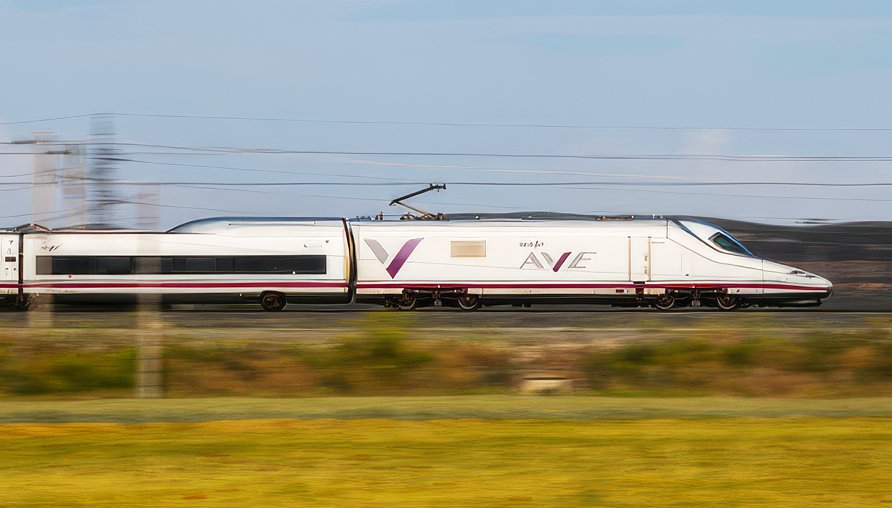
AVE: Spain’s high-speed trains

AVE is Renfe’s main high-speed train service, connecting many of Spain’s major cities – think Madrid, Barcelona, Seville, Málaga, Valencia, Alicante and others.
Dogs up to 40 kg can travel without a carrier on eligible AVE departures.
This is particularly exciting for dog-friendly travel because AVE makes it possible to combine cities that would otherwise involve several hours of driving. Madrid and Barcelona, Madrid and Andalusia, or Madrid and Valencia can suddenly become much more realistic parts of the same itinerary when you’re traveling with a larger dog.
 

Avlo: Renfe’s low-cost high-speed trains

Avlo is Renfe’s lower-cost high-speed service.
Dogs up to 40 kg are also now accepted without a carrier on eligible Avlo trains, which means the large-dog option is no longer limited to Renfe’s standard high-speed and long-distance services.
There are different ticket and pricing conditions for Avlo, which we’ll cover in the booking and price sections below.
 

Long Distance: Alvia, Euromed and Intercity

Renfe’s Larga Distancia, or Long Distance, services include trains such as:
  • Alvia
  • Euromed
  • Intercity
These trains connect many Spanish cities and regions that aren’t always covered by AVE alone, so their inclusion is one of the reasons the new rules make such a difference.
For dog travelers, this means we’re no longer talking only about a handful of famous high-speed routes. A much broader part of Spain’s railway network is now potentially accessible with a medium or larger dog.
 

Avant: shorter high-speed journeys

Avant trains are designed mainly for shorter and medium-distance high-speed journeys between Spanish cities.
Dogs up to 40 kg are now allowed on eligible Avant services too, although there is one important difference: your dog cannot travel on the seat on Avant trains and must remain on the floor.
We’ll look at exactly where dogs travel on each type of train in the next sections.
 

Media Distancia: regional and medium-distance trains
Renfe’s Media Distancia trains connect cities and towns across individual regions and between nearby parts of Spain.
And yes – dogs up to 40 kg are included here too.
This may actually be one of the most useful parts of the change for travelers who want to go beyond the classic Madrid–Barcelona–Seville triangle and build a slower, more regional itinerary.
On standard Media Distancia services, dogs traveling under the up-to-40-kg scheme must stay on the floor rather than on a passenger seat, and the pricing works differently from AVE, Avlo and Long Distance trains.

IMPORTANT NOTE: Look for the paw 🐾 sign before you book

Now for the fundamental little asterisk.
 
The fact that a route is operated by one of these train categories does not automatically guarantee that the up-to-40-kg dog option is available on every departure.
When searching for your journey on Renfe, look for the paw symbol 🐾 indicating that the specific train accepts dogs under the large-dog scheme.
Renfe also excludes trains that involve:
  • a connection between trains, or
  • a scheduled alternative transport plan, such as part of the journey being replaced by another form of transport.

Which Dogs Cannot Use Renfe’s Up-to-40-kg Service?

This restriction applies specifically to dogs traveling without a carrier under the new 40 kg service:

  • Dogs classified in Spain as potentially dangerous dogs, commonly called PPP dogs
  • Puppies and young dogs under 1 year old
  • Female dogs in heat
You can check availability and the latest conditions directly on Renfe’s official traveling-with-pets page.

Where Do Dogs Travel on Renfe Trains?

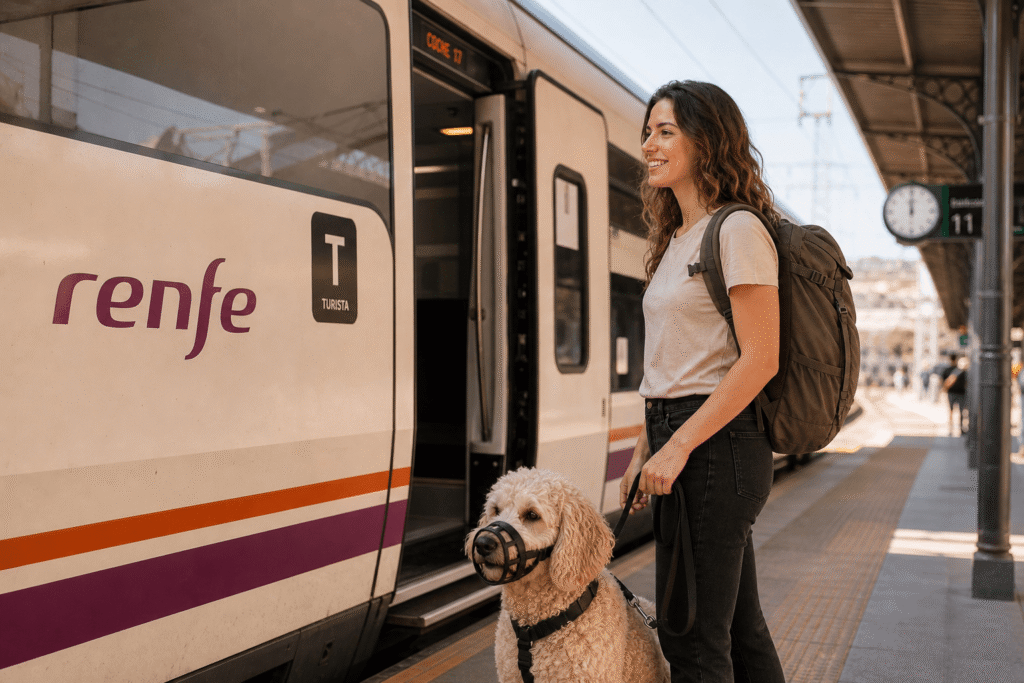
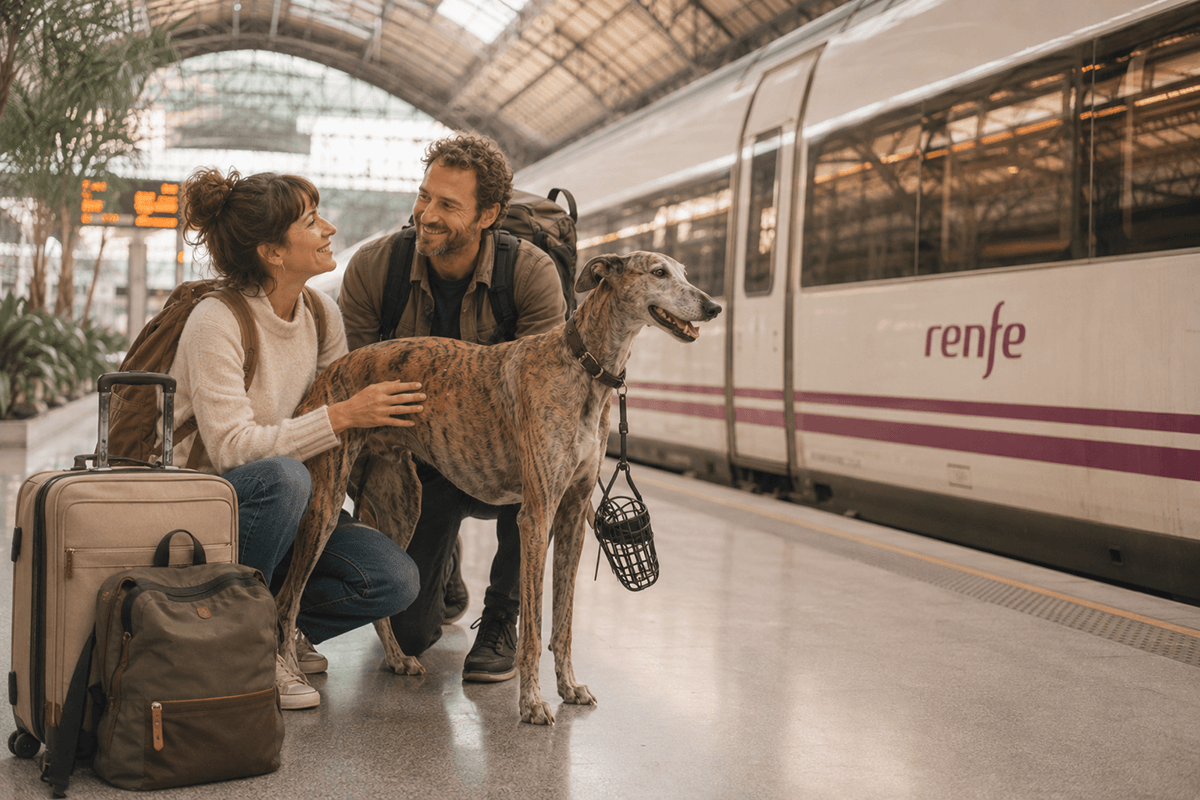
This is one of the nicest parts of Renfe’s new large-dog policy: on AVE, Avlo and Long Distance trains, your dog can travel right beside you rather than being separated in a luggage area or confined to a carrier.
And yes, for some very lucky woofers, that means an actual window seat.

AVE, Avlo and Long Distance: your dog travels beside you

On AVE, Avlo and Larga Distancia trains, dogs using the up-to-40-kg service are assigned the seat next to their owner, in the inside/window position.
Renfe predetermines these pet-friendly seats, so when you book the large-dog option you cannot choose your own seat. The system assigns you to the designated pet-friendly carriage, where a maximum of two large dogs can travel on each train.
 
During the journey, your dog must remain beside you in their assigned area and secured with their leash until you reach your final destination.
Honestly, I love this part of the new system. Traveling is stressful enough for some dogs without adding “Where have my humans disappeared to?” to the experience. Being able to stay right beside you makes the journey feel much more like traveling together.
 

Can my dog lie on the floor instead?

Renfe provides a protective seat cover and a floor mat for dogs traveling on AVE, Avlo and certain Long Distance services. The floor mat is placed beside the window seat, giving your dog a protected area next to you during the journey.
So, particularly for larger dogs who would rather stretch out than sit upright admiring the Spanish countryside, there is space for them to settle beside you while remaining in their designated area.
Renfe currently provides this travel kit on AVE, Avlo, Euromed, Intercity and Avant trains. It includes:
  • a protective cover for the seat
  • a mat for the floor beside the window seat
You collect the kit when accessing or boarding the train and remove it when your journey ends.

Avant and Media Distancia: dogs must stay on the floor

The rules are different on Avant and Media Distancia trains.
Although dogs up to 40 kg can travel without a carrier on these services, they are not allowed to travel on the passenger seat.
Instead, your dog must remain on the floor beside you during the journey.
 
Avant passengers receive Renfe’s travel kit, but Media Distancia passengers do not, so don’t expect the same setup you would get on an AVE or Long Distance train.
Regardless of train type, Renfe requires travelers using the large-dog service to bring their own cleaning supplies, which we’ll cover in the documents-and-packing section below.
 

Important rule: your dog must stay in their designated area.

Once you’re on board, the idea is not that your dog gets free rein to explore the carriage and make friends with the cute Pomeranian on row 12.
Your dog must remain secured and beside you in the assigned pet-friendly space for the journey. Renfe requires a non-retractable leash of no more than 1.5 metres, although the muzzle that is mandatory in the station and during boarding and disembarking can normally be removed once you’re traveling.
That fixed seating arrangement is worth considering when choosing which journey will be most comfortable for your dog.
A two-hour high-speed train with their human sitting right beside them may be perfectly manageable for a calm, experienced traveler. A much longer journey with a dog who finds trains overwhelming is a different story – even if the ticket technically allows it.
 
This is where I always come back to the same rule with dog-friendly travel: “allowed” and “comfortable” are not necessarily the same thing.
When we plan dog-friendly trips through Spain, we look at the whole journey – travel time, breaks, hotel location, weather, sightseeing plans and your dog’s personality – rather than simply checking whether a train or hotel has a paw symbol.
Because getting your dog on board is step one. Making sure they actually enjoy the trip is the part that matters.
Pinterest graphic showing a Renfe train and Wander Woofs mascot Chilli with the headline “Can large dogs travel by train in Spain? Renfe’s new rules explained.
Planning a dog-friendly train trip through Spain? Save this guide to Pinterest so Renfe’s new rules are always just one paw away.

How Much Does It Cost to Take a Dog On A Renfe Train?

For dogs up to 40 kg with no carrier:

For dogs up to 40 kg traveling without a carrier, Renfe charges €40 on AVE, Avlo and Long Distance trains. On Avant and Media Distancia, there is no fixed €40 price: the dog supplement costs the equivalent of a full General Fare ticket for that journey.
So, unfortunately, there isn’t one universal “dog ticket” price across the whole Renfe network.
 

AVE and Long Distance: €40, but only with the right passenger ticket

On AVE and Long Distance trains, the large-dog supplement costs €40 per journey.
There is an important booking condition, though: Renfe currently offers the up-to-40-kg service on these trains only when the human traveler has an Elige Estándar ticket.
So when comparing fares, don’t simply choose the cheapest passenger ticket you see and assume you can add your dog afterwards. Make sure the fare itself is compatible with the large-dog option before completing the booking.
 

Avlo: €40 on top of your Básica fare

On Avlo, Renfe’s low-cost high-speed trains, the dog supplement is also €40.
Here, the system works slightly differently: you purchase your regular Básica fare and then add the Perros hasta 40 kg extra.
That makes the dog price nice and predictable:
Your Avlo ticket + €40 for your dog.
 

Avant and Media Distancia: the price depends on the journey

This is where things become less straightforward.
On Avant and Media Distancia trains, the large-dog supplement costs the equivalent of one General Fare ticket for that particular journey, on top of your own passenger ticket.
In other words, there is no single fixed price I can give you here. A dog’s ticket will depend on the route you are traveling.
And yes, depending on the journey, your furry travel companion may effectively have a fare much closer to yours than the €40 charged on long-distance trains.
They may not have a wallet, but apparently they do have transportation expenses.
 

For dogs under 10 kg inside a carrier:

If your dog is Chilli-sized and traveling inside a carrier, the pricing is different.
On AVE and Long Distance trains:
  • the pet ticket is free with a Prémium ticket
  • with Básico or Elige, the pet ticket costs €10
  • with a Bono AVE, the pet supplement costs 25% of the Standard-seat journey price
On Avlo, a pet up to 10 kg traveling in a carrier costs €10.
On Avant and Media Distancia, the pet ticket costs 25% of the General Fare.
So this is one area where being tiny still comes with financial perks. Sorry, big woofers.

Renfe train Pets up to 10 kg in a carrier Dogs up to 40 kg without a carrier
AVE €10 with Básico or Elige tickets.
Free with eligible Prémium tickets.
€40 supplement.
Available with an Elige Estándar ticket.
Avlo €10 €40 supplement, added to the passenger's Básica fare.
Long Distance
Including applicable Alvia, Euromed and Intercity services
€10 with Básico or Elige tickets.
Free with eligible Prémium tickets.
€40 supplement.
Available with an Elige Estándar ticket.
Avant 25% of the General Fare. The equivalent of one full General Fare ticket, added to the passenger's ticket.
Media Distancia 25% of the General Fare. The equivalent of one full General Fare ticket, added to the passenger's ticket.
Cercanías Free Free. Cercanías has no pet weight limit.

Important: Prices and eligibility depend on the exact train, fare and availability. Travelers should always confirm the current conditions on Renfe's official pet travel page before booking.

Can Dogs Travel on Cercanías Trains in Spain?

Yes. Dogs can still travel on Renfe Cercanías trains without a weight limit, and the rules are separate from the new up-to-40-kg service used on long-distance trains.
On Cercanías services:
  • Pets travel free of charge and do not need their own ticket.
  • There is no weight limit.
  • A carrier is not required.
  • A maximum of one pet per person is allowed.
  • Dogs must be kept on a leash and wear a muzzle.
Renfe lists dogs, cats and birds among the domestic animals accepted on these commuter trains.
 
This means the €40 supplement, designated pet seat and two-dogs-per-train limit discussed elsewhere in this guide do not apply to Cercanías. These are local commuter services connecting cities with their surrounding areas – known as Rodalies in Catalonia – rather than AVE or other long-distance trains.
 
Still, allowed and comfortable are not always the same thing. Cercanías trains can become very crowded, particularly during rush hour, so quieter travel times are usually kinder to both your dog and your fellow passengers.
 
Heading to Barcelona? Our complete guide to using public transport in Barcelona with a dog explains the different rules for the metro, buses, trams, FGC and Rodalies – because naturally, every operator has its own little rulebook.

What I recommend as a professional travel expert:

As a professional travel expert, from my work in my travel company Experience Wanderlust and its pet-friendly division, Wander Woofs, this is something I would pay attention to when planning a multi-city trip through Spain with a dog.
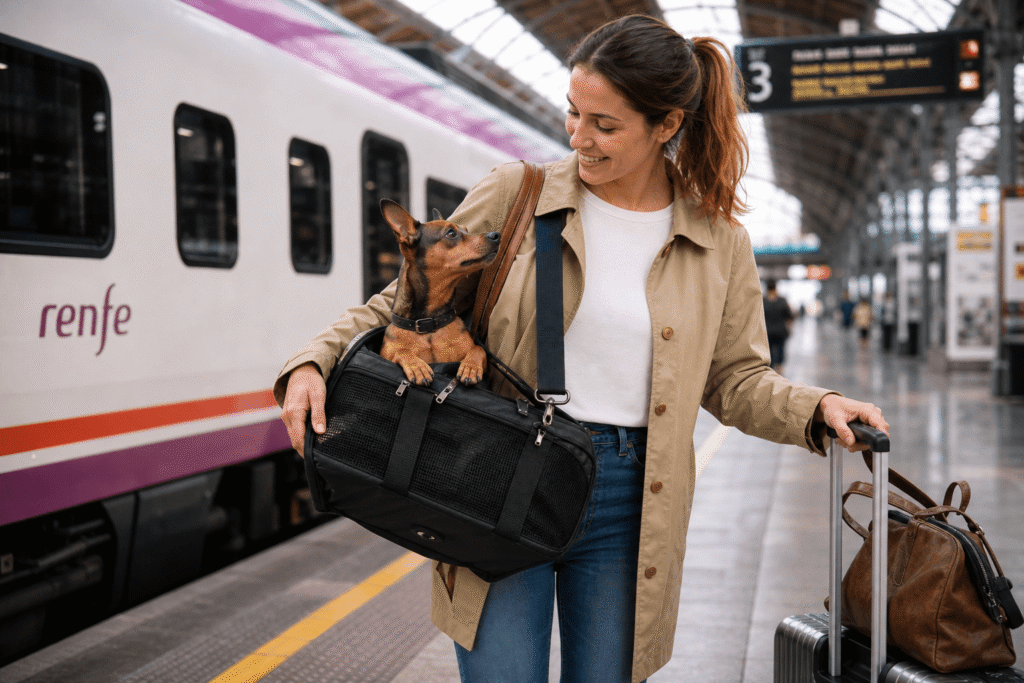
The cheapest-looking train for the humans isn’t necessarily the cheapest – or most comfortable – option once you add the dog’s fare and consider where your dog will travel.
 
For example, one departure might cost a little more for you but offer a €40 fixed dog supplement and a much shorter journey. Another may have a cheaper passenger ticket but charge the dog the equivalent of a General Fare ticket.
When we build pet-friendly trips in Spain, this is exactly the kind of detail we look at as part of the whole itinerary: not just “Can the dog go?” but which option actually makes the most sense for that particular dog, route and travel day.
 
Because sometimes paying a little more for a shorter, simpler train ride with fewer logistical headaches is money very well spent – especially when one member of the travel party has four legs and absolutely no interest in your spreadsheet.
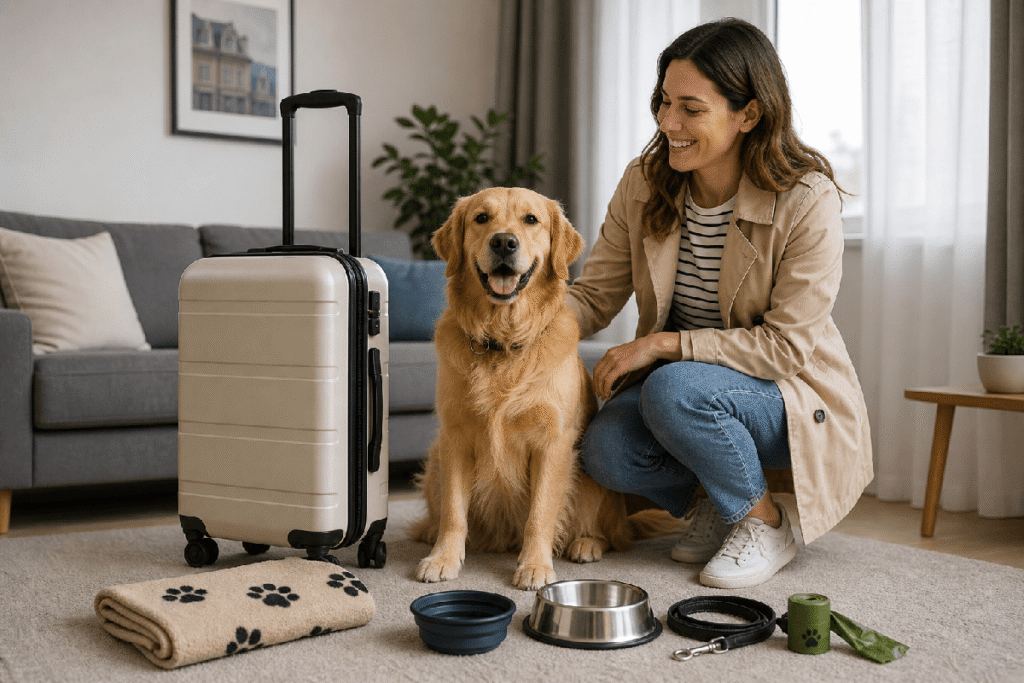
Traveler preparing for a train trip with a Golden Retriever, suitcase, blanket, bowls, leash and dog waste bags.

What You Need to Bring: The Wander Woofer's Travel Kit

If your dog is traveling under Renfe’s up-to-40-kg scheme, you’ll need more than just the dog ticket. Renfe requires specific documentation, liability insurance, a suitable leash, a muzzle and your own cleaning kit – and you can be refused travel if you arrive without the required documents or equipment.
So before heading to the station, here is the dog-travel checklist I would actually save on my phone.
 

What you MUST bring

For dogs traveling without a carrier under the up-to-40-kg service, Renfe requires:
  • an up-to-date vaccination booklet or pet passport
  • mandatory civil liability insurance for your dog
  • a non-retractable leash, maximum 1.5 metres long
  • a muzzle
  • your own cleaning kit
  • an adult traveler responsible for the dog
Renfe’s current rules also state that the person traveling with the dog must be able to prove that they are 18 or older.
If you are coming to Spain from another country, remember that Renfe’s train requirements are only one part of the picture. Your dog must also comply with the rules for entering Spain and the EU.
 

What kind of leash does Renfe require?

The leash must be non-retractable and no longer than 1.5 metres.
During the journey, Renfe requires your dog to remain secured to the seat or the front footrest and to stay in their assigned area until you reach your destination.
Your dog can’t wander through the carriage, and you also can’t simply leave them alone at your seat while you disappear for a coffee. If you need to go to the toilet, Renfe says the dog should remain secured to the front footrest or the inside/window seat. In an exceptional situation, you may take the dog to the toilet with you.
 
Yes, this is not the most glamorous part of Spanish train travel, but definitely the kind of detail you want to know before you are three carriages away from your dog.
 

What documents do I need for my dog?

Renfe requires you to carry and present either an up-to-date vaccination booklet or your dog’s pet passport.
For international travelers, this will often be the EU Pet Passport or the documentation required to legally enter the European Union with your dog. Because entry requirements vary depending on where you are traveling from, I would sort out the international pet paperwork first and then treat the Renfe requirements as an additional layer of your trip planning.
 
Read our free Ultimate Guide To Traveling With Dogs In Europe for all the EU travel requirements in much more detail.

Yes, liability insurance is required.

This is an easy one to miss because it doesn’t appear as prominently as the muzzle or pet-passport requirements.
Renfe’s July 2026 conditions state that the traveler must have mandatory civil liability insurance for the dog. That means this is something I would verify before booking your train, particularly if you are visiting Spain from abroad and your existing pet insurance policy was issued in another country.
Don’t assume that having general travel insurance automatically means your dog has the required liability cover.
 

Your dog needs a cleaning kit too

When I say that having a dog can be like having a kid… This is what I mean. Every traveler using the large-dog service must bring their own cleaning kit containing, at minimum:
  • an absorbent pad
  • cleaning wipes
  • poop bags
  • disinfectant and deodorising spray
If your dog has an accident, you are responsible for cleaning the area immediately.
Renfe may have an additional cleaning kit available onboard some AVE, Alvia, Euromed, Avlo and Intercity trains, but that is additional backup, not a replacement for the kit you are required to bring yourself.
 
Basically, you need to pack as though your dog will behave impeccably, but prepare as though they may choose the exact moment you board a high-speed train to reconsider all their toilet training.
Because sometimes dogs have impeccable timing like that.
 

What does Renfe provide?

On most trains included in the large-dog scheme, Renfe provides a complimentary travel kit consisting of:
  • a protective seat cover
  • a mat for the floor beside the window seat
The exception is Media Distancia, where this travel kit is not provided.
Remember that this is different from your cleaning kit: the cleaning supplies are still your responsibility.
 

Other recommendations from Renfe and my own experience traveling with my dog in trains:

The following are recommendations rather than mandatory requirements, but they make a lot of sense from the dog’s point of view.
Renfe recommends:
  • bringing your dog’s own blanket
  • bringing a familiar quiet toy
  • taking your dog for a good walk before entering the station
  • giving them enough exercise before the journey to help them settle
  • avoiding food during the three hours before departure
  • using lifts or fixed stairs rather than escalators and moving walkways
  • considering a veterinary check before the journey, particularly for longer trips
Renfe even recommends bathing your dog the day before traveling to help avoid strong smells onboard. Chilli would like it formally recorded that he always considered pre-travel grooming an entirely reasonable expectation for a gentleman heading on holiday, but besides plain vanity, I believe good grooming also helps challenge the idea that dogs don’t belong on trains or planes because they’re “dirty” or shed everywhere. Clean dogs make better ambassadors, so let’s keep the paws clean and the stereotypes off the carriage!
 

My real-world advice: practice before travel day
Rules aside, one thing I would add from years of traveling with Chilli is this: don’t make the actual journey the first time your dog encounters their travel equipment.
 
Chilli was a tiny Yorkshire terrier, so this was always our side of the dog-travel equation.
When you travel with a dog that fits comfortably inside a carrier, you quickly discover that being tiny comes with certain transport privileges. Trains, flights and even some urban transport systems can become considerably simpler when your dog and carrier fit within the small-pet limits.
Of course, explaining that to the small dog in question is another matter.
 
Chilli may have technically traveled as a “pet in carrier,” but I’m fairly certain he considered himself an international traveler who happened to have private accommodation. And sometimes, even well-behaved dogs will try to demand a “carrier-to-lap” upgrade…
 
That’s why the carrier itself matters enormously, though. Your dog may be allowed on the train, but that doesn’t automatically mean they will be comfortable spending several hours inside it. Before a longer journey, I would make sure your dog is already familiar with their carrier and treats it as somewhere safe to settle – not as the mysterious box that only appears five minutes before something stressful happens.
 
Let them get used to the muzzle. Take them into busy environments. Practice settling quietly beside you. Bring the blanket that smells like home rather than buying a pristine new “travel blanket” the night before.
For some dogs, a two-hour train ride is simply an opportunity for an excellent nap.
For others, stations, announcements, people, luggage, doors and movement are a huge amount of stimulation.
 
And that is why good dog-friendly travel planning is never just about finding places where dogs are technically allowed. Through our pet-friendly travel planning services, we look at the trip from your dog’s perspective too – transport, journey length, hotel setup, rest time and what happens on the days when your plans and your dog’s needs don’t quite match.
 
Because the goal isn’t simply to get your dog to Spain. It’s for both of you to enjoy being here.
A great way to get your dog clean for traveling. (Yes, this is a joke, but it's such a great photo of Chilli, I couldn't help post it here!)

How to Book a Renfe Ticket for a Dog Up to 40 kg

Renfe’s website is notorious for being difficult to navigate, and as a Barcelona local, I can tell you that Spaniards love to hate this company. But they are the biggest railway company in all of Spain, so here are some tips to help you book your VIP (very important puppy) train ticket so you can join him on a dog-friendly Spanish holiday:

When searching for your journey, look for the paw symbol 🐾 beside the departure. This confirms that the train offers Renfe’s large-dog service and still has one of the limited pet places available.

Choose your passenger ticket first, then add the “Perros hasta 40 kg” extra during the booking process. The supplement can be purchased through the Renfe website, the Renfe app or an authorised travel agency, but it must be booked no later than 24 hours before departure.

On AVE and Long Distance trains, the service is linked to the Elige Estándar fare. On Avlo, it is added to the passenger’s Básica fare. Your seat and your dog’s designated place are assigned automatically, so seat selection is not available.

The dog supplement cannot be changed separately. It may be cancelled, but the refund will depend on the cancellation conditions of your own passenger ticket. Because only two dogs using the up-to-40-kg service are accepted on each train, booking early is definitely the wiser move – especially on popular routes and busy travel dates.

Planning a Dog-Friendly Train Trip Around Spain - And How Wander Woofs Can Help!

Getting your dog onto the train is only one part of the journey. A comfortable trip also depends on choosing genuinely pet-friendly hotels, planning realistic travel days, finding dog-friendly activities and knowing what to do when a museum, monument or restaurant cannot welcome your furry companion.
 
Wander Woofs can help plan the full dog-friendly itinerary – including accommodation, transport, experiences and trusted dog-sitting when paws cannot come along.
 
You enjoy Spain; we handle the tail-wagging logistics. 

Frequently Asked Questions About Traveling With Dogs on Renfe Trains

  • Can dogs travel on Renfe trains in Spain?

Yes. Dogs can travel on Renfe trains, but the conditions depend on their weight and the type of train. Dogs up to 10 kg generally travel inside a carrier, while dogs up to 40 kg can travel without one on eligible AVE, Avlo, Long Distance, Avant and Media Distancia services.

  • Can a dog weighing up to 40 kg travel without a carrier?

Yes. Renfe allows dogs weighing up to 40 kg to travel without a carrier on participating trains. Look for the paw symbol when booking to confirm that the service is available on your exact departure.

  • Does every Renfe departure accept large dogs?

No. The service is available across Renfe’s main train categories, but not every individual departure will necessarily offer it. Trains involving connections and those with scheduled alternative transport plans are excluded.

  • Does my dog need to wear a muzzle?

Dogs using the up-to-40-kg service must wear a muzzle inside the station and while boarding and leaving the train. During the journey, the muzzle can normally be removed, but the dog must remain secured with a non-retractable leash no longer than 1.5 metres.

  • Where does a large dog travel on the train?

On AVE, Avlo and Long Distance trains, the dog travels in the designated window-side place beside its owner. On Avant and Media Distancia trains, dogs cannot travel on the seat and must remain on the floor.

  • How much does it cost to take a large dog on Renfe?

The supplement costs €40 on AVE, Avlo and Long Distance trains. On Avant and Media Distancia, the cost is equivalent to a full General Fare ticket, added to the passenger’s own ticket.

  • How many large dogs are allowed on each train?

Renfe permits a maximum of one large dog per passenger and two large dogs per train, both traveling in one predetermined carriage. With so few canine places available, booking early is a very good idea. Dogs under 10kg traveling inside a carrier bag are limited to this rule. 

  • Can puppies, females in heat or PPP dogs use the 40 kg service?

No. Renfe excludes dogs under one year old, females in heat and dogs classified in Spain as potentially dangerous breeds, commonly known as PPP dogs, from the up-to-40-kg service.

  • Can dogs under 10 kg still travel inside a carrier?

Yes. Pets weighing up to 10 kg can continue traveling inside a carrier measuring no more than 60 × 35 × 35 cm. Their ticket price and conditions depend on the type of train and passenger fare.

  • Can all dogs travel on Cercanías trains?

Yes. On Cercanías trains, pets travel free, without a weight limit or separate ticket. Dogs must be kept on a leash and wear a muzzle, and only one pet is permitted per passenger.

  • What documents do I need for my dog?

For the up-to-40-kg service, passengers must carry an updated veterinary-stamped vaccination booklet or a valid European Pet Passport. Always check the latest requirements on Renfe’s official pet travel page before departure, because transport rules have a habit of changing when our tails are turned.
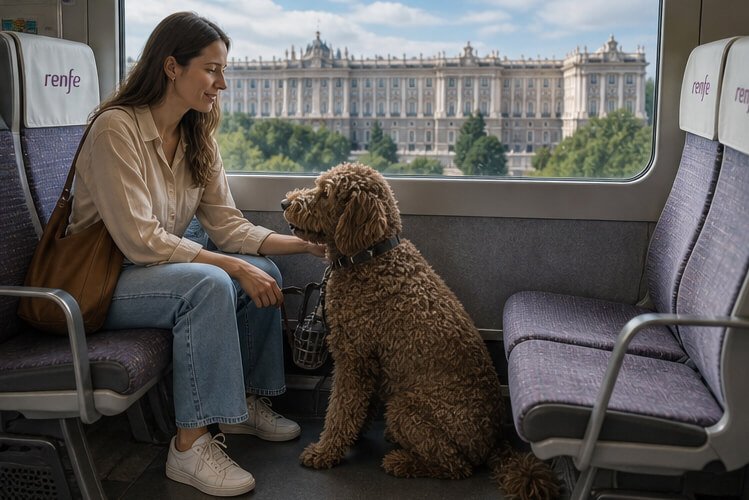
Ready to Explore Spain With Your Dog?

Renfe’s new rules make traveling around Spain with a medium or large dog much easier – but the train ticket is only one part of a truly dog-friendly trip. The right hotels, realistic travel days, dog-friendly experiences and a plan for places where paws cannot enter matter just as much.

Through our Wander Woofs pet-friendly travel planning service, we can help organize accommodation, transport, local logistics, activities and trusted dog care around your dog’s needs. And if Spain is part of a bigger adventure, our guide to traveling with dogs in Europe will help you prepare for the journey across borders.

Ready to turn those new train routes into a real adventure? Tell us where you want to go – and let’s plan a trip that works for every member of the family, paws included.