

Updated: September 2026
By Vick Fichtner, founder of Wander Woofs
An EU Pet Passport sounds wonderfully simple when you are planning to travel to Europe with your dog – almost too simple. Unfortunately, pet travel paperwork loves making simple things complicated.
An EU Pet Passport and an EU animal health certificate are different travel documents. An EU Pet Passport is mainly used for eligible pet travel between EU countries, while an EU animal health certificate is generally used when a dog enters the EU from a non-EU country. Which one you need depends on where you live, where your dog is traveling from and your route.
Your exact requirements can depend on your country of departure, country of entry, travel route and your dog’s health history, so always check the latest official rules for your particular journey before traveling.
In this guide, I’ll explain exactly how the two documents differ, who needs each one, how long they remain valid, what happens if you’re American but live in Europe, and the common paperwork mistakes to avoid before you and your four-legged travel companion head for the airport.

EU Pet Passport vs EU Animal Health Certificate: Key Differences
An EU Pet Passport and an EU animal health certificate both record important information about your dog, including identification and rabies vaccination details, but they are designed for different travel situations.
The simplest way to remember the difference is this: an EU Pet Passport is mainly for eligible pets traveling within the EU, while an EU animal health certificate is generally used to enter the EU from a non-EU country.
And if all this paperwork already has you feeling slightly overwhelmed, I completely understand. I traveled extensively around Europe with my little Yorkie, Chilli, and I have personally lived through some very stressful – occasionally full-on panic-inducing – moments at airports because of pet documents.
| EU Pet Passport | EU Animal Health Certificate | |
|---|---|---|
| Main purpose | Travel between EU countries | Entering the EU from a non-EU country |
| Who usually uses it? | Pet owners who are resident in the EU | Travelers bringing a pet into the EU from outside the EU |
| Who issues it? | An authorised veterinarian | An official State veterinarian, or an authorised veterinarian with the required official endorsement |
| When do you get it? | Once your pet meets the applicable requirements | Before traveling to the EU |
| Entry validity | No 10-day entry window; it remains usable while the required health information is current | Normally must be issued no more than 10 days before arrival and document checks at the EU entry point |
| Travel within the EU | Can continue to be used for eligible journeys while valid | After entry checks, it can generally be used for further EU travel for up to 6 months or until the rabies vaccination expires, whichever comes first |
| How long does it last? | Potentially for the pet's lifetime, provided health information such as rabies vaccination remains up to date | Temporary travel document |
| Typical example | A Spain-based dog traveling to France and Italy | A US-based dog arriving in Spain for a European holiday |
Why This Difference Matters Before You Travel
One thing I learned the hard way is that having the correct paperwork does not always mean the person checking it will immediately understand it. Airlines and airport staff can make mistakes too, especially when pet travel regulations change, different countries apply different procedures, or a member of staff simply does not deal with four-legged passengers very often. Standing at an airport desk wondering whether someone is going to let your dog board a flight is definitely not the kind of excitement you want at the beginning of a holiday.
That experience is actually one of the reasons pet-travel planning is such an important part of what we do at White Paws by Wander Woofs. We want our four-legged clients – and their humans – to travel with as much clarity and as little stress as possible, from the first planning stages to arriving safely at their destination.
So, for my fellow already-stressed-out pet parents, I created the table below to make the difference between the two documents as clear as possible. Keep reading, though, because we’ll go through each one in detail and cover the situations where things get a little more complicated.
What Is an EU Pet Passport?
An EU Pet Passport is an official identification document for dogs, cats and ferrets that follows a standard European Union format and is used for eligible pet travel between EU countries.
Despite the name, you do not need to be an EU citizen to get one. What matters is residency: according to the EU’s official guidance, European pet passports are issued to pet owners who are resident in the EU.
That distinction is incredibly important, because “Can an American get an EU Pet Passport?” sounds like a nationality question, when in practice residency is the key part of the answer.
And this is exactly the sort of detail that can turn into a stressful airport moment if you only discover it while someone is checking your dog’s papers at the counter.
When I traveled with Chilli, I quickly learned to treat his travel documents with almost the same level of attention as my own passport. Maybe more, actually – nobody ever inspected my passport to see when my last rabies vaccine was.
The paperwork can feel ridiculously complicated when all you are trying to do is take your dog on holiday with you. But once you understand what each document actually does, the whole system becomes much easier to navigate.
What information does an EU Pet Passport contain?
A European Pet Passport records the information authorities need to identify your dog and verify that the relevant health requirements have been met. It includes:
- your dog’s description and identification details;
- microchip number or, where legally applicable, tattoo information;
- rabies vaccination records and other relevant health information;
- the owner’s contact details;
- details of the veterinarian who issued the passport.
The passport itself is valid for life, but that does not mean you can put it in a drawer for five years and assume everything inside is still valid. Your dog’s health information – especially the rabies vaccination – must remain up to date for the passport to continue working as a valid travel document.
I always tell pet parents to think of it this way: the booklet may not expire, but the information inside it can.
And that tiny distinction matters a lot when there is a flight, a hotel booking and an impatient dog waiting on the other side of the check-in desk.
How do you get an EU Pet Passport?
If you are resident in the European Union, you can obtain an EU Pet Passport for your dog from an authorised veterinarian who is permitted by the relevant national authorities to issue pet passports.
Your dog will need to meet the applicable identification and health requirements – including a compliant microchip and valid rabies vaccination – before the passport can be used for travel.
This is another area where I strongly recommend not leaving things until the week of your trip.
Pet travel rules are one of those subjects where one missing date, one vaccination recorded incorrectly or one misunderstood requirement can suddenly become a very big problem at the airport. And believe me, arguing about veterinary paperwork while watching the boarding time get closer is not character-building. It is just horrible.
At Wander Woofs, this is exactly why we look at the journey from beginning to end: not only “Is this hotel dog-friendly?”, but also “What documents does this dog need? Does the route make sense? What needs to be checked before departure? And where could something go wrong?”
Our goal is simple: less airport panic for humans, more tail-wagging for everyone involved.

What Is an EU Animal Health Certificate?
If the EU Pet Passport is the long-term travel document, think of the EU animal health certificate as the temporary document that gets your dog into the European Union from a non-EU country.
It is an official EU-standard document used for non-commercial travel with dogs, cats and ferrets arriving from outside the EU. It records your pet’s identity and health information and confirms that the relevant EU entry requirements have been met.
For many Wander Woofs clients, this is the document that matters most at the beginning of the journey. If you live in the United States, Canada, Brazil or another non-EU country and are bringing your dog to Europe for a holiday, this is usually the document you should be looking at first — not an EU Pet Passport.
And this is where I want to add one piece of advice from someone who has stood at airport counters with Chilli’s documents in one hand and a rapidly increasing heart rate in the other: do not assume that “I have the certificate” means you are finished.
Dates matter. Signatures matter. Microchip numbers matter. The order in which things were done can matter. And the person checking your documents may not deal with international pet travel every day.
I have been in situations where airline or airport staff were unsure about the rules — or interpreted them differently — even when I had done my homework. Pet travel regulations change, procedures vary between countries and airlines, and human beings make mistakes on both sides of the counter. And yes, it can be absolutely terrifying.
That is why my philosophy with Wander Woofs White Paws is not simply “get the paperwork.” It is understand the paperwork, check the route, verify the timing and know what you are going to show if someone questions it. The goal is to solve as many potential problems as possible before you and your dog are standing under the Departures sign.
What information does an EU animal health certificate contain?
The certificate includes the information authorities need to identify your dog and verify compliance with EU health requirements, including:
- your dog’s identification and microchip details;
- rabies vaccination information;
- details of a rabies antibody titration test when one is required;
- treatment against Echinococcus multilocularis when applicable;
- confirmation that the animal is fit to travel;
- information about the owner and the non-commercial nature of the journey.
A written declaration confirming that the movement is non-commercial must also accompany the animal health certificate. In other words, this system is designed for someone traveling with their own pet — not importing an animal for sale or a change of ownership.
Who issues the EU animal health certificate?
The certificate must be completed through the official veterinary process in the country your dog is departing from.
Under the current EU rules, it is issued by an official veterinarian or, where the national system allows it, completed by an authorised veterinarian and subsequently endorsed by the competent authority.
This is an important detail because a regular vaccination record from your local vet is not the same thing as an EU animal health certificate.
For example, US travelers normally need to follow the official USDA process for EU pet travel rather than simply asking their veterinarian for a general health letter.
And please — this is not the document to start researching the night before your flight. Your dog may be relaxed enough to nap on the suitcase while you panic-Google veterinary paperwork at midnight, but I promise there are better ways to begin a European holiday.

When do you need an EU animal health certificate?
For most travelers arriving with a dog from a non-EU country, the EU animal health certificate is valid for 10 days from the date it is issued until your dog completes the required documentary and identity checks when entering the EU.
You can check the current European Commission rules for bringing pets into the EU before traveling.
That 10-day rule is about entering the EU, and it is one of the most misunderstood parts of the whole process. It does not mean that your certificate suddenly becomes useless ten days into your holiday.
Once your dog has entered the EU and successfully completed the required checks, the same certificate can generally be used for further travel between EU countries for up to six months, or until the rabies vaccination expires, whichever happens first.
So if you are planning a longer European trip, you do not normally need a new animal health certificate every time you cross into another EU country.
And that little distinction can save an already stressed pet parent from a completely unnecessary mini-meltdown.
Important: EU Animal Health Certificate Changes From October 2026
Because we are publishing this guide in September 2026, there is an important upcoming change you should know about.
The EU has introduced a new animal health certificate model under its updated pet travel rules. Certificates issued under the previous model can still be used for entry into the EU if they are issued before October 1, 2026. Travelers whose certificates are issued from October 1 onward should make sure their veterinarian is using the current EU model.
This is exactly the kind of rule change that can create confusion at veterinary offices, airline desks and airports during a transition period.
And it is exactly why I always recommend checking the official requirements for your actual travel date, even if you traveled with the same dog to Europe last year — or even a few months ago.
“Chilli did this trip before” was never a legal travel document, unfortunately.
EU Pet Passport or Animal Health Certificate: Which Do You Need?
By this point you may be thinking: Okay, Vick, I understand the difference – but which one does my dog actually need?
Fair question.
This is the part I always wished pet-travel rules explained more clearly. When you are planning an international trip with a dog, you do not want to decode pages of regulations just to figure out which piece of paper applies to you. You want someone to say: “You live here, you are traveling from here – this is the document you should be looking at.”
So, let’s make it simple.
If you are traveling from the US, Canada, Brazil or another non-EU country
If your dog is entering the European Union from a non-EU country, you will generally need an EU animal health certificate for that journey.
The certificate is only one part of the entry requirements. Depending on the country you are traveling from, your dog may also need a valid microchip, rabies vaccination, rabies antibody titration test, or additional treatments and documentation.
There are some exceptions for pets traveling with recognised pet passports issued by certain non-EU countries and territories, so “non-EU country = always health certificate” is a useful general rule, but not an absolute one.
And this is exactly where I would resist the temptation to Google the question once, read the first answer and call it a day.
When Chilli and I traveled, I learned that the safest approach was always to check the rules for our exact country of departure, destination, and date of travel. Pet regulations have enough little exceptions – and enough changes over time – to turn a confident “I know this already” into a very uncomfortable conversation at an airline counter.
If you are traveling between EU countries
If you are resident in the EU and your dog has a valid EU Pet Passport, that passport is normally the document used for eligible travel between EU countries.
This was one of the beautiful things about having Chilli properly documented once we were living in Europe. We traveled together a lot, and having one ongoing pet travel document made moving between European countries much easier than preparing temporary paperwork for every trip. Plus, how cute is it to know that your dog has an actual passport of their own?
But there is an important twist for visitors: if you entered the EU from a non-EU country using an EU animal health certificate, you do not normally need to obtain an EU Pet Passport just because you then continue traveling within the EU.
Once your dog has successfully entered the EU, that validated health certificate can generally continue to cover onward travel within the EU for up to six months, or until the rabies vaccination recorded in it expires, whichever comes first.
Thankfully. Your dog has much better things to do in Europe than collect veterinary paperwork at every border.

If you are American – or another non-EU citizen – but live in the EU
This is one of the most misunderstood situations.
Your nationality does not prevent you from having an EU Pet Passport. What matters much more here is residency.
For example, an American who lives in Spain with their dog may be eligible to obtain an EU Pet Passport from an authorised veterinarian, provided the relevant requirements are met. An American who lives in the United States and is simply visiting Spain with their dog would normally use an EU animal health certificate to enter the EU instead.
Same nationality. Very different travel situation.
And I want to emphasise this because it is exactly the sort of misunderstanding that gets repeated online until everyone is confused – sometimes including people who work around travel every day.
EU residency and your dog’s travel route matter more here than the nationality printed on your own passport.
So no, your dog does not need to wait for you to become European before getting a European passport. Chilli the Yorkie actually got his European passport way before I got mine, true story!
If you are traveling from Great Britain to the EU
Great Britain is a separate case because England, Scotland and Wales are no longer treated as EU departure points for pet travel.
If you are traveling with your dog from Great Britain to an EU country, you will generally need an Animal Health Certificate (AHC) before entering the EU. It must follow the current UK requirements and be signed by an Official Veterinarian.
A new certificate is generally required for each new trip from Great Britain into the EU.
Once you have entered the EU, however, that certificate can generally be used for onward travel within the EU for up to six months, provided the relevant health requirements – including the rabies vaccination – remain valid.
And here is another small-but-important detail: Great Britain and Northern Ireland do not follow exactly the same pet travel rules.
So whenever you find an article talking vaguely about “UK pet travel rules,” check what it actually means. Advice for someone traveling from London may not be identical to advice for someone traveling from Belfast.
That is exactly the kind of tiny geographical detail that looks harmless when you are reading about it from your sofa and suddenly feels much less tiny when your flight boards in 40 minutes.
My rule before any international trip with a dog
After years of traveling with Chilli – including a few airport moments I would happily remove from my personal travel highlight reel – and helping my clients travel with their pets in Europe, I developed one very simple rule:
Never check only which document your dog needs. Check the entire journey.
Before traveling, I want to know:
- where the dog is departing from;
- where they will first enter the EU;
- whether they will continue into other countries;
- whether the rabies vaccination remains valid for the whole journey;
- whether the country of origin requires additional testing;
- whether the destination requires any specific treatment;
- and what the airline itself requires for that particular flight.
Because this is another lesson I learned the stressful way:
Government entry requirements and airline boarding requirements are not necessarily the same thing.
Your dog may meet the legal requirements to enter Spain and you can still encounter a problem at check-in because the airline has additional documentation, carrier or transport requirements – or simply because the person behind the counter interprets a rule incorrectly.
Yes, airlines and airports make mistakes too.
I have been there with Chilli, knowing I had done my homework and still feeling my stomach drop while someone questioned his paperwork. That feeling of watching the clock, your dog beside you, and wondering whether a misunderstanding is about to derail the whole trip is something I would very happily prevent other pet parents from experiencing.
That is a big part of why we created White Paws by Wander Woofs.
We look at pet-friendly travel as a complete journey: documentation, routes, flights and transport, hotels, activities, dog-friendly logistics and all those little friction points that tend to appear somewhere between “we’re going to Europe!” and actually getting there.
We cannot guarantee that an airline employee will never make a mistake. But we can help you travel better prepared, knowing what your dog needs, what the official rules say and where potential problems may appear before they become airport-sized problems.
Because traveling with your dog should feel like the beginning of an adventure – not an immigration exam you forgot to study for.
Can a Non-EU Citizen Get an EU Pet Passport?
Yes, if they are official residents of the European Union. EU nationality is not the key requirement here – residency is. An American living in Spain may be able to obtain an EU Pet Passport for their dog, while someone living in the US and visiting Europe would normally travel with an EU animal health certificate instead.
If your situation is more complicated – for example, you are moving to Europe, traveling through several countries, or are unsure which document applies to your route – get in touch with us!
We can review your trip and help you work out the correct pet-travel requirements without the hours of contradictory Googling and airport stress.
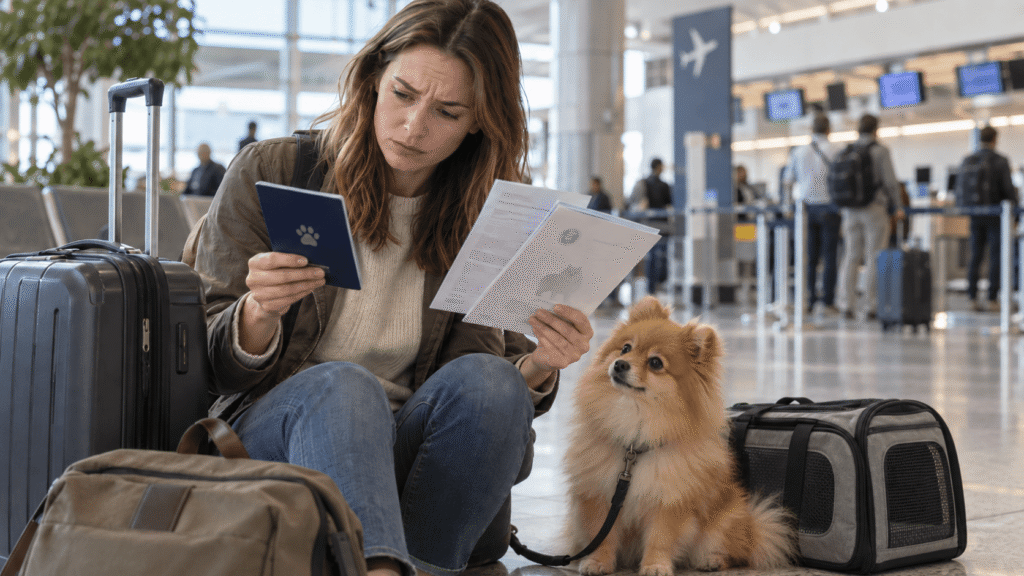
Traveling to Spain With a Dog: EU Pet Passport or Health Certificate?
If Spain is your first point of entry into the EU and if you entered the EU from outside the EU, your dog will generally need an EU animal health certificate rather than an EU Pet Passport. If you are already resident in the EU and traveling to Spain from another EU country, you would normally travel with your dog’s valid EU Pet Passport.
There is also an important middle ground: if you entered the EU from outside Europe with a valid animal health certificate and then continue your trip to Spain, you can generally keep using that certificate for travel within the EU for up to six months, or until the rabies vaccination expires, whichever comes first. You do not need to rush off and get your dog an EU Pet Passport halfway through your holiday.
If Spain is your first point of entry into the EU from a non-EU country, your dog may also need to pass through a designated travellers’ point of entry where the authorities can carry out the required document and identity checks. This is one of those details I always want sorted out before anyone books flights – not discovered after landing with luggage, a tired dog and zero desire for a surprise conversation with border authorities.
And remember: getting your dog legally into Spain is only one part of the trip. Airlines have their own pet policies, and once you arrive you still have hotels, trains, restaurants, attractions and all the wonderfully inconsistent meanings of “pet-friendly” to deal with.
That is where White Paws by Wander Woofs comes in. We help plan the whole pet-friendly journey – not just getting your dog across the border, but making sure the itinerary actually works once all those paws arrive in Spain.
Not sure which document applies to your particular trip? Contact Wander Woofs and let us look at your route, origin and travel plans with you.
Sometimes paying someone to untangle the paperwork is considerably more enjoyable than spending three evenings with seventeen browser tabs open and no idea which one to trust.
Common EU Pet Travel Document Mistakes
Pet travel paperwork is one of those things that looks manageable right up until one tiny detail suddenly matters a lot.
I learned this traveling with my yorkie. And after enough airports, check-in desks and “wait… why are they saying this now?” moments, I stopped treating pet documents as something to simply tick off a list.
Here are the mistakes I would most want another pet parent to avoid.
1. Assuming an EU Pet Passport and an Animal Health Certificate are interchangeable
They are not. An EU Pet Passport and an EU animal health certificate serve different purposes, and having one does not automatically mean it is the right document for your particular journey.
Before traveling, check the official EU pet travel rules for where your dog is coming from, where they are entering the EU and which document applies to that movement.
This sounds obvious once you have read this article. Before you understand the system? Not so much.
2. Leaving the paperwork until the last minute
Some pet-travel requirements involve waiting periods that you simply cannot fix by paying extra at the airport.
For example, under EU rules, your dog must be microchipped before the rabies vaccination used for travel is given, and after a first rabies vaccination there is normally a minimum 21-day waiting period before travel.
That is why my rule is: start checking pet requirements before you book the trip, not after. If you are still planning the bigger picture, our guide to traveling with dogs in Europe covers the main entry requirements and travel planning basics.
A missing document may be fixable. A biological waiting period is considerably less impressed by your non-refundable flight.
3. Letting a rabies vaccination expire without realising the consequences
A rabies booster is not something I would leave until “we’ll do it sometime before the trip.”
If the booster is given before the previous vaccination expires, the vaccination coverage can remain continuous. If it lapses, the new vaccination may be treated as a primary vaccination and the waiting period can apply again.
This is exactly why I used to check Chilli’s dates long before we headed anywhere near an airport, and I had a permanent annual vet appointment in my calendar for his rabies vaccine.
The document may look perfectly fine. One expired date inside it can tell a very different story.
4. Misunderstanding the famous 10-day rule
This one causes a lot of unnecessary panic.
For pets entering the EU from many non-EU countries with an animal health certificate, the certificate is generally valid for 10 days from issue for entry into the EU. After entry, it can generally cover onward travel within the EU for up to six months, or until the rabies vaccination expires, whichever comes first. Check the European Commission’s official guidance for pets entering from a non-EU country for the current rules.
So no, a three-week European holiday does not automatically mean your paperwork self-destructs on Day 11.
Pet travel is stressful enough without adding imaginary deadlines.
5. Assuming the airline and the government are checking exactly the same thing
This is a big one.
Being legally allowed to enter a country and being allowed to board a particular flight are two different questions.
Airlines can have their own rules about carriers, weight, cabin travel, breeds, documentation and how pets are booked. And yes — airline and airport staff can misunderstand pet regulations too, especially when rules are changing.
I have personally been at an airport with Chilli knowing that I had checked the requirements and still found myself having to explain or defend his paperwork.
Not fun.
Since then, one of my personal habits has been to travel with the relevant official rules easily accessible, not just something I remember reading three weeks earlier. I want to be able to show where the information comes from if somebody at check-in sees things differently.
That does not guarantee there will never be a problem. It gives you a much better starting point than “but I saw on a Facebook group that this was okay.”
6. Checking the destination but forgetting the actual route
Your final destination is not always the only place that matters.
If your dog is arriving from outside the EU, the first EU country they enter can determine where the required documentary and identity checks take place. Pets entering from relevant non-EU countries generally need to pass through a designated travellers’ point of entry.
This becomes especially important when flights involve connections.
And this is where I deliberately stop giving one-size-fits-all instructions, because routes, countries and individual circumstances can change the answer.
7. Trusting an old blog post more than the current official rules
Yes, I am saying this inside a blog post.
Pet travel rules change. Certificate models change. Countries can introduce new requirements. Airlines update policies. Information that was completely correct when someone wrote it may not be correct when you travel.
That is why we use official EU and national sources as the starting point for our pet-travel planning — and why I recommend checking them again close to departure.
The internet is wonderful. It also has a remarkable ability to keep a 2019 answer alive forever.
When in doubt, ask before you book
If your journey is straightforward, the official guidance may give you everything you need.
If it is not — multiple countries, unusual routing, a relocation, connecting flights, confusing paperwork, or simply that horrible feeling of “I think I understand this, but I really don’t want to discover that I’m wrong at the airport” — that is exactly where White Paws by Wander Woofs can help.
We review the pet-friendly journey from beginning to end so our four-legged clients and their humans can travel better prepared, with fewer surprises and considerably less airport panic.
Because I have been that stressed person standing there with a dog and a folder of documents. I would much rather help you avoid becoming her.
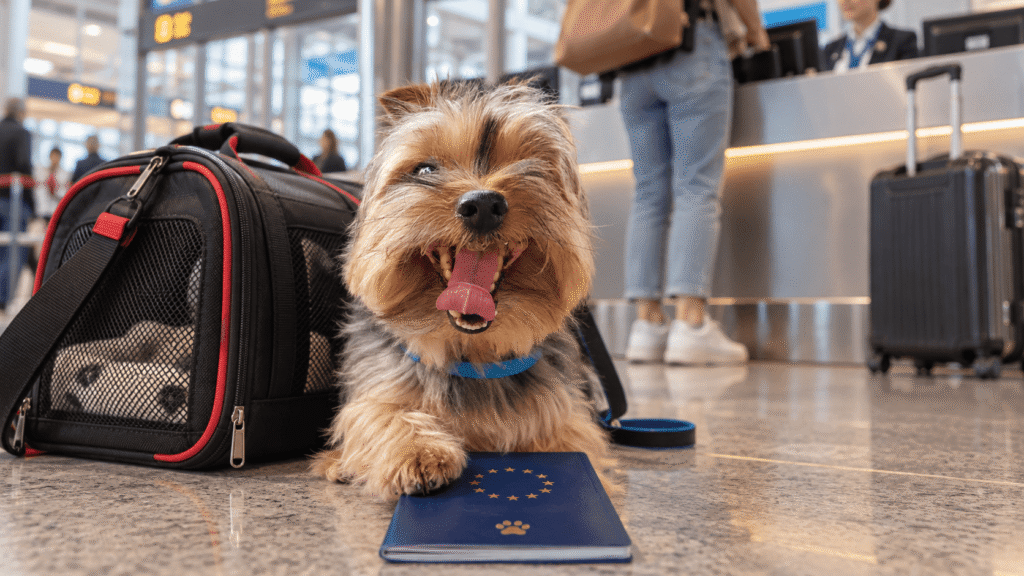
How Wander Woofs Helps With Pet-Friendly Travel in Europe
Traveling with a dog in Europe is not just about getting the paperwork right. Once you arrive, you still have to figure out pet-friendly hotels, transport rules, restaurants, attractions, ferries, trains, flights and all the little logistics that can turn a beautiful itinerary into a very complicated one when four paws are involved.
That is exactly why we created White Paws by Wander Woofs.
We help travelers plan pet-friendly trips from beginning to end, looking at the journey from the dog’s point of view as well as the human’s. That can include reviewing routes and pet-travel requirements, finding genuinely dog-friendly accommodation, understanding transport restrictions and planning what to do when a place you really want to visit does not allow dogs.
And sometimes, the best pet-friendly solution is simply not making your dog come everywhere with you.
Many of Europe’s museums, monuments and major attractions do not allow pets inside. Instead of leaving your dog alone at the hotel – or skipping somewhere you have dreamed of visiting – Wander Woofs also offers trusted tourist dog-sitting services in Spain. A sitter can care for your dog nearby while you explore, with walks, water breaks, cuddles and photo updates along the way.
It is the same philosophy I developed after years of traveling with Chilli: a truly dog-friendly trip is not about forcing your dog into every part of the itinerary. It is about creating a trip that works comfortably for both of you.
With White Paws, we want our four-legged clients and their humans to enjoy Europe with less paperwork panic, fewer “are dogs allowed here?” surprises, and much more actual traveling.
Need help planning your trip?
Contact Wander Woofs and tell us where you and your dog are dreaming of going. We’ll help make the journey work from the first document check to the last tail wag.
FAQ: EU Pet Passports and Animal Health Certificates
Is an EU Pet Passport the same as an animal health certificate?
No. An EU Pet Passport is mainly used for eligible pet travel between EU countries, while an EU animal health certificate is generally used when a pet enters the EU from a non-EU country. They contain some of the same health and identification information, but they serve different travel purposes.
Do I need an EU Pet Passport to travel to Europe with my dog?
Not necessarily. If you are traveling to the EU from a non-EU country, your dog will usually need an EU animal health certificate for entry rather than an EU Pet Passport. The exact requirements depend on your country of departure, destination and your dog’s health records.
Can I travel around the EU with an animal health certificate?
Yes, in many cases. After your dog has entered the EU and completed the required checks, the same animal health certificate can generally be used for onward travel within the EU for up to six months or until the rabies vaccination expires, whichever comes first.
Does an EU Pet Passport expire?
The passport itself can remain valid for your dog’s lifetime, but the health information inside it must stay current. In particular, your dog’s rabies vaccination must remain valid for the passport to be usable for travel.
Can a non-EU citizen get an EU Pet Passport?
Yes, if they are resident in the European Union and their dog meets the applicable requirements. EU citizenship is not the deciding factor; residency is.
Do I need a new animal health certificate for every EU country I visit?
Usually not. If your dog entered the EU correctly using a valid animal health certificate, that document can generally continue to cover onward travel within the EU during its permitted validity period.
What happens if my dog’s rabies vaccination expires?
If the rabies vaccination lapses, a new vaccination may be treated as a primary vaccination rather than a booster, which can trigger a new waiting period before travel. This is why vaccination dates should be checked well before booking flights.
Are airline pet rules the same as EU entry rules?
No. Government entry requirements and airline pet policies are separate things. An airline may have its own rules about cabin travel, carriers, weight limits, breeds, bookings or additional documentation, even if your dog meets the legal requirements to enter the destination country.
What if I am still not sure which document my dog needs?
Pet-travel rules can become complicated quickly when multiple countries, connections or special health requirements are involved. Wander Woofs can review your route and help you understand what needs to be checked before you travel, so you are not trying to solve it all at the airport.

About the author:
Vick Fichtner is the founder of Wander Woofs and spent years traveling throughout Europe with her Yorkshire Terrier, Chilli. Wander Woofs now helps travelers plan pet-friendly trips in Europe and provides tourist dog-sitting services in Spain.