
Last updated: July 29, 2026 – including Renfe’s new rules for dogs up to 40 kg.
You finally made it to the capital of Spain with your furry friend, but then comes the question: Can I take the metro with a dog in Madrid?
I’m happy to say that the answer to that is yes – and that is genuinely good news if you are planning to explore the city with your furry travel companion. Madrid is big, sunny, busy, exciting, and, depending on your dog’s personality, either a wonderful urban adventure or a dramatic documentary titled Small Dog, Big Feelings.
The good part is that Madrid Metro can be a very useful way to move around with a dog. The slightly less glamorous part is that you need to know the rules before you arrive at the station: muzzle, short lead, last carriage, time restrictions, and a few practical details that can make the difference between a smooth ride and a full-body sigh from both human and dog.
After years of planning city days around dogs, I have learned that the official rule is only half of the story. The other half is your actual dog: their size, confidence, heat tolerance, patience, and very personal opinion about crowded platforms. Dogs do have opinions. Usually strong ones.
In this guide, I’ll walk you through Madrid Metro, EMT buses, Cercanías, Metro Ligero and Renfe trains, with the practical dog-parent perspective I wish every transport page had.
If Madrid is only one stop in a bigger trip, you may also want to read our guide to traveling with dogs in Europe, especially if you are planning transport, documents, and pet-friendly logistics across more than one country.
Quick Answer: Can I take the metro with a dog in Madrid?
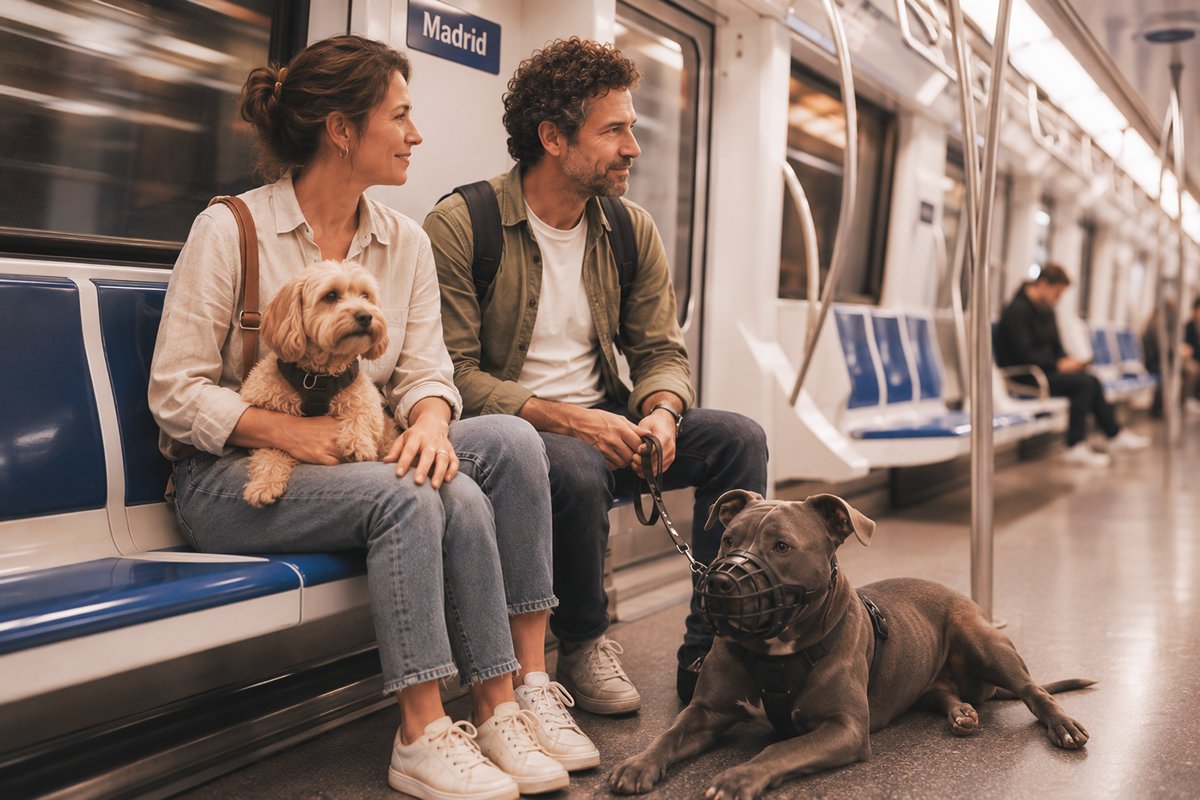
Yes. Dogs are allowed on Madrid Metro if they follow the official access conditions:
- one dog per traveler;
- microchip identification;
- muzzle;
- lead no longer than 50 cm;
- travel in the last carriage of the train;
- no access during weekday peak hours: 7:30–9:30, 14:00–16:00 and 18:00–20:00.
These peak-hour restrictions apply from Monday to Friday. In July, August, on weekends and on public holidays, dogs can travel on Madrid Metro throughout the normal service day.
So, is Madrid Metro pet-friendly? Yes, with rules. It is not a “clip the lead and improvise” situation, but it can work beautifully if you plan your timing, keep your dog close, and do not treat the Metro like a pawsome endurance challenge.
What about dogs in the Metro Ligero in Madrid?
Metro Ligero (ML1, ML2, ML3, and ML4) are Madrid’s light rail system – a tram-like service that connects some areas outside the main city center and works as part of the wider public transport network. Most short tourist stays in central Madrid will not depend on it, but it can appear in your route if you are staying farther out or visiting specific suburban areas.
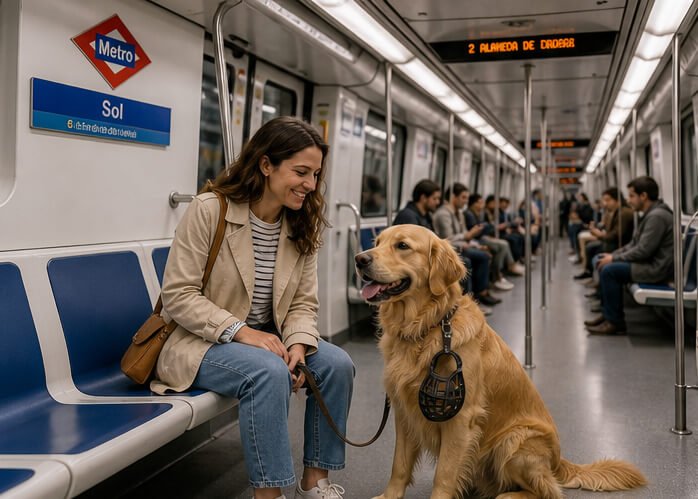
Dogs can travel on Metro Ligero in Madrid, but the rules depend slightly on the line and operator. As a general dog-parent rule, treat Metro Ligero like Madrid Metro: muzzle, short lead, no seats, one dog per traveler, and avoid restricted weekday peak hours.
On Metro Ligero Oeste, dogs must travel in the designated areas indicated by the operator and cannot occupy a seat. They must wear a muzzle and stay on a short lead, and the same weekday peak-hour restrictions apply. Access is restricted from Monday to Friday during peak hours: 7:30–9:30, 14:00–16:00 and 18:00–20:00. On weekends, public holidays, and throughout July and August, dogs can travel during the full service day.
Metro Ligero 1 follows Madrid Metro’s general animal access rules, but dogs should travel in the central cars rather than the last carriage. Tiny detail? Yes. Useful if you want to avoid standing there with your dog, wondering whether “last carriage” applies to every rail-shaped creature in Madrid? Also yes.
Most short Madrid city trips will not require Metro Ligero, so do not overthink it unless your route actually uses it. But if it does, check your line, put the muzzle on before entering, keep your dog close, and plan as you would with Metro: calm timing, short lead, and no heroic “we can totally make it through rush hour” decisions.
Your dog is on holiday too. Even if they did not book the trip, approve the hotel, or understand why humans love museums so much.
Can dogs go on buses in Madrid?
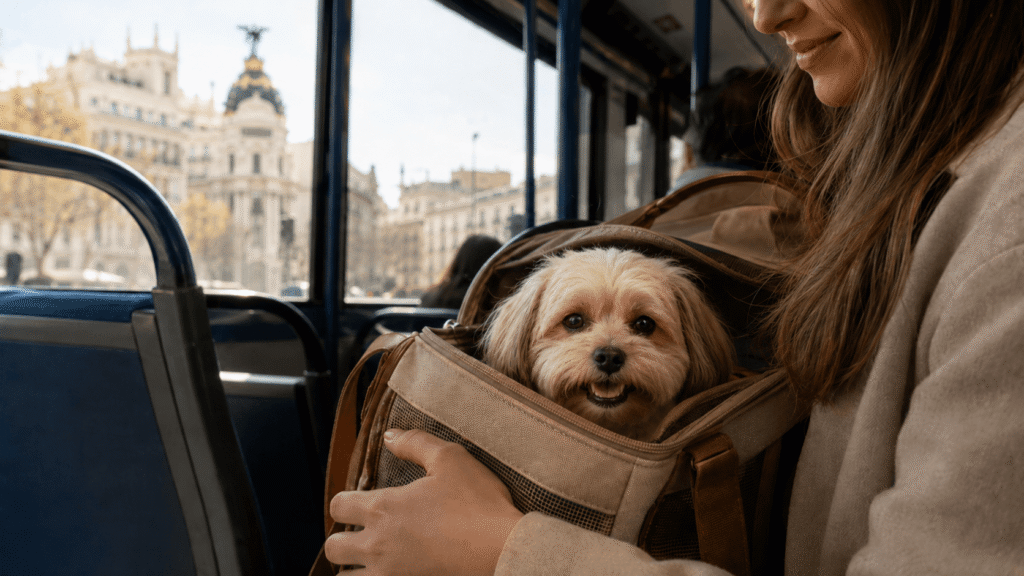
Dogs can only travel on EMT city buses in Madrid in very limited situations. Assistance dogs can travel on EMT buses without a carrier, while other small pets are allowed only when they travel inside a suitable carrier and do not create a danger or nuisance for other passengers.
For most travelers with medium or large dogs, this means Madrid buses are not the easiest option. I know, it would be lovely if every bus arrived with a little “welcome aboard, distinguished floof” announcement – but sadly, no. Madrid buses are much more restrictive than the Metro or Cercanías.
This is one of the most common misunderstandings I see with dog-friendly city travel. People read that Madrid is becoming more pet-friendly and assume that means all public transport works the same way. Sadly, it does not. A dog that can ride the Madrid Metro with a muzzle and short lead will not automatically be allowed on an EMT bus.
For small dogs, a proper carrier can make buses possible. Chilli was lap-sized, so I did manage to take the bus with him whenever he had his carrier, but for larger dogs, I would plan around Metro, Cercanías, walking routes, taxis or pet-friendly travel support instead.
My advice? Do not build your whole Madrid itinerary around buses unless your dog is small, carrier-trained and calm.
Can dogs travel on the Cercanías Trains in Madrid?
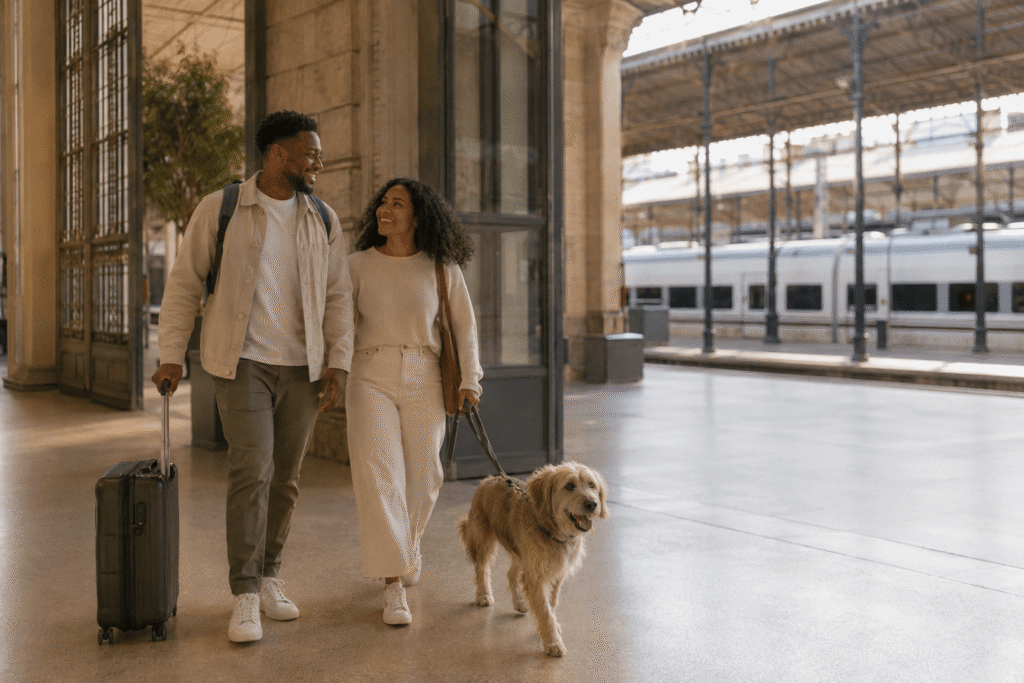
Yes, dogs can travel on Cercanías Madrid, and honestly, this is one of the more useful options for dog parents moving around the wider Madrid area.
On Cercanías trains, pets travel for free and do not need their own ticket. Dogs, cats and birds are accepted without a weight limit, and dogs do not need to travel inside a carrier. Dogs must be on a lead and wear a muzzle, and each traveler can bring one pet.
This makes Cercanías much more flexible than EMT buses, especially if you are traveling with a medium or large dog. It can be helpful if you are staying outside the very center, visiting nearby areas, or simply trying to avoid a complicated chain of Metro changes with a dog who has not personally approved the route.
That said, “allowed” and “comfortable” are not always the same thing. Cercanías trains can still get busy, especially during commuting hours. I would avoid the most crowded times when possible, choose a calmer carriage, keep your dog close, and carry water in warm weather.
For confident city dogs, Cercanías can work really well. For anxious dogs, elderly dogs, heat-sensitive dogs or pups who consider every platform a stage for emotional theatre, give yourself extra time and keep the journey gentle.
Can I take my dog on Renfe trains from Madrid?
Yes – and this became much easier for medium and large dogs in July 2026.
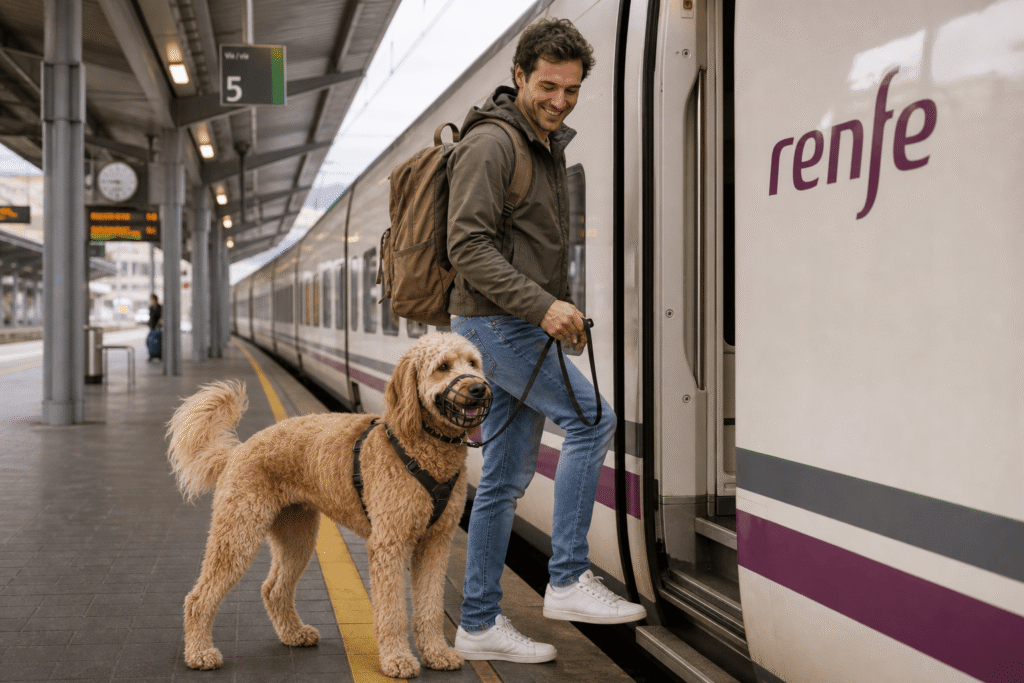
Renfe now allows dogs up to 40 kg to travel without a carrier on AVE, Avlo, Long Distance, Avant and Media Distancia trains, subject to availability and the conditions of the specific train.
This is a major change from the previous system, when the large-dog option was limited to selected AVE routes.
When searching for your journey, look for the little paw symbol 🐾. That tells you that the specific departure offers Renfe’s dogs-up-to-40-kg service.
There are still some important rules:
maximum 1 large dog per passenger
maximum 2 large dogs per train
dogs must be at least 1 year old
females in heat cannot use the service
dogs classified as potentially dangerous breeds are excluded
muzzle and leash requirements apply
the price and where your dog travels depend on the type of train
And what about the tiny travelers?
Dogs and other permitted pets up to 10 kg can still travel inside a carrier, with maximum dimensions of 60 × 35 × 35 cm, under Renfe’s existing small-pet rules.
So nothing has disappeared for the Chilli-sized passengers. 🐾
The new rules simply mean that traveling around Spain by train has become possible for many more dogs.
For the full breakdown — including dog-ticket prices, seating, muzzles, documents, booking rules and the differences between AVE, Avlo, Long Distance, Avant and Media Distancia – read our complete guide to traveling on Renfe trains with a dog in Spain.
You can also check the latest conditions directly on Renfe’s official pet travel page.
And what about Cercanías trains in Madrid?
Cercanías follows completely different rules.
On Renfe Cercanías trains:
there is no dog weight limit
pets travel free
they do not need their own ticket
dogs do not need to travel inside a carrier
dogs must travel on a leash and wearing a muzzle
maximum 1 pet per passenger
That makes Cercanías one of the easiest options for getting around the wider Madrid area with a medium or large dog.
And it is a good reminder that “Renfe” does not mean one universal pet policy: the rules depend on the type of train you are taking.
Madrid Public Transport With Dogs at a Glance
| Transport mode | Are dogs allowed? | My dog-parent take |
|---|---|---|
| Madrid Metro | ✅ Yes, with rules | One dog per traveler, muzzle, max. 50 cm lead, last carriage and weekday peak-hour restrictions. |
| EMT city buses | ⚠️ Small pets only | Small pets can travel inside a suitable carrier. Not practical for medium or large dogs. |
| Cercanías Madrid | ✅ Yes, no weight limit | Free, no carrier required, leash + muzzle. One of the easiest options for larger dogs. |
| Metro Ligero | ✅ Yes, with rules | Muzzle, short lead and timing restrictions apply; check the specific line and operator. |
| Renfe intercity trains | ✅ Yes, dogs up to 40 kg | Pets up to 10 kg can travel in carriers; dogs up to 40 kg can travel without one on eligible AVE, Avlo, Long Distance, Avant and Media Distancia trains. |
| Taxi / Uber Pet | ✅ Yes, depending on service | Often the easiest backup when your dog is tired, you have luggage or public transport becomes unnecessarily complicated. |
Wander Woofs practical tips for using Madrid public transport with a dog
Here is the part I would tell you if we were chatting over coffee before your Madrid trip: the rules matter, of course, but your dog matters more.
A transport system can be officially dog-friendly and still be too hot, too crowded, too noisy or too stressful for your particular dog at that particular moment. I learned this years ago planning city days with dogs – and especially with Chilli, who was small, clever, well-behaved, and still perfectly capable of giving me a very clear “absolutely not, human” face when a plan was not Chilli-approved.
So yes, Madrid public transport can work really well with a dog. But I would plan it gently, with a little strategy and a lot of common sense.
Avoid rush hour whenever you can.
Even when dogs are allowed, crowded platforms and packed carriages are not fun for most dogs. Madrid is a busy city, and your dog does not need to experience the full commuter lifestyle to prove they are cultured.
Practice the muzzle before the trip.
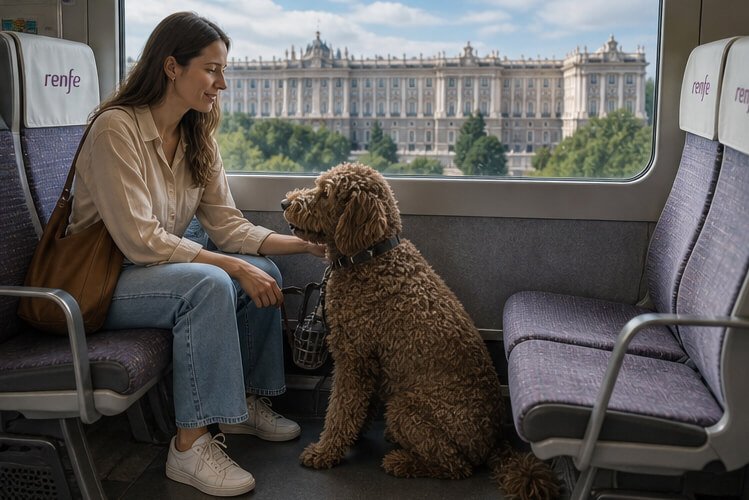
If your dog is not used to wearing a muzzle, do not make the first attempt at the Metro entrance. That is how tiny rebellions begin. Let your dog get comfortable with it at home first, with treats, patience and zero drama.
Keep the lead short, but stay relaxed.
Madrid Metro requires a lead no longer than 50 cm, so your dog needs to stay close. This is good for safety, but your energy matters too. If you are tense, your dog will probably read the room and decide the underground is a suspicious kingdom.
Use lifts and stairs when needed, but avoid escalators.
Dogs are not allowed on escalators or moving walkways on Madrid Metro. Even beyond the rule, I would avoid escalators with dogs whenever possible. Paws, nails, moving metal stairs… no thank you. I actually saw a dog get his paws stuck on the top of the escalator once, and not only was it extremely painful for the dog, but also for us who were watching. Not only can escalators be dangerous for paws, but using them with a dog is also against Madrid Metro rules. We are here for tapas and beautiful city walks, not emergency paw choreography and a crazy high vet bill.
Choose quieter stations and simpler routes.
A direct route with one calm transfer is usually better than a “technically faster” route with three changes, seven platforms and a dog wondering why their holiday has become an urban obstacle course.
Bring water, especially in warm months.
Madrid can get very hot, and underground stations can feel stuffy. I always think of water as part of the dog-parent survival kit, along with poop bags, treats, patience and the ability to apologize gracefully when your dog decides to sniff someone’s suitcase like it contains state secrets.
Protect your dog’s paws in summer.
Madrid pavements can get extremely hot. If you are walking to or from stations during summer, check the ground temperature and choose shaded routes when possible. Small dogs, elderly dogs and short-nosed breeds may need extra care.
Do not overpack the day.
This is the mistake I see all the time with pet-friendly travel. People plan the day like humans with Google Maps, not like humans traveling with a dog who needs pauses, sniffing time, water breaks and emotional processing.
Have a backup plan.
Sometimes the best dog-friendly decision is not public transport. If your dog is tired, anxious, overheated, or you have luggage, a taxi or ride app may be worth it. Always confirm with the driver before getting in.
Think about your attraction plans before you move across the city.
This is a big one. Many of Madrid’s major museums and monuments are not dog-friendly inside, so there is no point crossing the city with your dog only to discover you cannot enter together. Plan transport and dog care as one itinerary, not two separate puzzles.
My personal rule is simple: if the journey feels like too much for the dog, change the plan. A good Madrid day with your dog should feel smooth, safe and happy — not like you are both auditioning for a reality show called Surviving Public Transport With Paws.
When public transport is not the best option
The Madrid public transport system can work well with a dog, but sometimes the kindest plan is not taking the Metro, Cercanías or Metro Ligero at all.
I would avoid public transport if your dog is anxious, elderly, heat-sensitive, not used to a muzzle, or already tired after a long day of walking. I would also think twice if you have luggage, several transfers, a timed museum entry, or a very hot Madrid afternoon ahead of you.
This matters because many of Madrid’s main museums, monuments and indoor attractions do not allow dogs inside. Public transport may get you to the door, but it does not solve the real dog-parent question: what happens while you go in?
Sometimes the better option is a taxi or ride app, a calmer walking route, a shorter itinerary, or arranging dog care near the attraction.
Madrid also has Uber Pet, which can be particularly useful when you’re traveling with luggage, heading to a train station with a larger dog, or simply trying to avoid a crowded Metro journey. Select Uber Pet in the app rather than requesting a standard ride, so you’re matched with a driver who accepts pets.
My rule is simple: if the route looks efficient for a human but stressful for the dog, change the plan. Your Madrid day should feel smooth for both of you – not like your dog has been accidentally booked into a public transport survival challenge.
That is where our pet-friendly travel planning services in Europe can make a huge difference: not just knowing where dogs are allowed, but building a day that actually works for both human and furry traveler.
How Wander Woofs helps dog travelers in Madrid
Wander Woofs helps dog parents enjoy Madrid without having to choose between their dog and the places they came all the way to see.
We offer pet-friendly travel planning and on-site dog-sitting for travelers visiting Madrid with dogs. That means we can help you plan a smoother dog-friendly trip, and we can also care for your dog while you visit places where paws sadly cannot enter.
For attraction days, the idea is simple: we meet you and your dog directly at the attraction entrance, take care of your dog nearby with a calm walk, water breaks and company, and meet you again when your visit is finished. No detour to a daycare, no leaving your dog alone at the hotel, no guilt soundtrack while you try to enjoy a museum.
This can be especially helpful if your Madrid itinerary includes places like the Prado Museum, the Royal Palace, Reina Sofía, Thyssen-Bornemisza, or other museums and monuments where dogs are not allowed inside.
Your dog gets a safe, relaxed mini-adventure. You get to enjoy Madrid’s big cultural moments. Everyone wins – especially the furry CEO, who probably had strong opinions about museums anyway.
Planning a dog-friendly trip to Madrid? Wander Woofs can help with pet-friendly travel planning and on-site dog-sitting, so your itinerary works for both humans and dogs.
FAQ about dogs on Madrid Metro and public transport
Can I take the metro with a dog in Madrid?
Yes. You can take the metro with a dog in Madrid if your dog is microchipped, wears a muzzle, stays on a lead no longer than 50 cm, and travels in the last carriage. One dog is allowed per traveler.
Is Madrid Metro pet-friendly?
Yes, Madrid Metro is pet-friendly, but with rules. It is a good option for many dog parents, as long as you avoid restricted hours, prepare the muzzle in advance, and keep your dog close.
What times can dogs travel on Madrid Metro?
Dogs can travel on Madrid Metro during normal service hours except Monday to Friday from 7:30–9:30, 14:00–16:00 and 18:00–20:00. In July, August, on weekends and on public holidays, dogs can travel throughout the full service day.
Do dogs need a muzzle on Madrid Metro?
Yes. Dogs must wear a muzzle on Madrid Metro, even if they are calm, tiny, angelic, or personally convinced they are above such things. I would practice at home before your trip so the muzzle does not become a dramatic plot twist at the station.
Can dogs go on buses in Madrid?
Only in very limited cases. Assistance dogs are allowed, and small pets can travel on EMT buses if they are inside a suitable carrier and do not disturb or endanger other passengers. For medium or large dogs, buses are usually not the best option.
Can dogs travel on Cercanías Madrid?
Yes. Dogs can travel on Cercanías Madrid for free, without a weight limit and without a carrier. They must stay on a lead, wear a muzzle, and each traveler can bring one pet.
Can dogs travel on Metro Ligero in Madrid?
Yes, dogs can travel on Metro Ligero, but rules depend slightly on the line. In general, expect Metro-style rules: one dog per traveler, lead, muzzle, no seats, and weekday peak-hour restrictions.
Can I take a dog over 10 kg on a train from Madrid?
Yes. Dogs weighing up to 40 kg can now travel without a carrier on eligible Renfe AVE, Avlo, Long Distance, Avant and Media Distancia trains.
The specific departure must offer the large-dog service, which is identified by a paw symbol 🐾 when booking. Renfe allows a maximum of one large dog per passenger and two per train, and additional conditions apply for tickets, muzzles, documentation and eligibility.
For the complete rules, see our guide to traveling on Renfe trains with a dog in Spain.
What is the easiest public transport in Madrid with a dog?
For many dog parents, Madrid Metro and Cercanías are the easiest options. Metro works well for moving around the city, while Cercanías can be more useful for wider Madrid routes. EMT buses are much more limited unless your dog is small enough to travel in a carrier.
What should I do if my dog cannot enter a museum or attraction in Madrid?
Plan dog care before you arrive at the door. Many Madrid museums and monuments do not allow dogs inside, so Wander Woofs can help with pet-friendly travel planning and on-site dog-sitting while you visit. Your dog gets company and a calm walk; you get to enjoy Madrid without the guilt soundtrack.
Madrid can be a wonderful city to explore with your dog, especially when you know which transport options actually work for your plans. The Metro and Cercanías can make many routes easier, but the best dog-friendly itinerary is always the one that keeps your dog safe, calm and included.
Need help planning your Madrid trip with your furry travel companion? Wander Woofs can help with pet-friendly travel planning and on-site dog-sitting, so you can enjoy museums, monuments and non-dog-friendly attractions without leaving your dog alone at the hotel. Your dog gets care, company and a happy little city break – and you get to enjoy Madrid with far less stress and far more tail-wagging.