You are currently viewing Can Dogs Access Public Transport in Barcelona? Updated Metro, Bus, and Train Rules

Can Dogs Access Public Transport in Barcelona? Updated Metro, Bus, and Train Rules

If you are planning to visit Spain and travel with your dog on public transport in Barcelona, this is one of those topics that sounds simple until you realise every operator has its own little rulebook. Very Barcelona, very charming, mildly chaotic.

Even after living in Barcelona for years with my sidekick (and Wander Woofs adorable mascot, Chilli the Yorkie), if there`s one thing I learned was to never take using public transportation with a dog in Barcelona for granted. Why? Because here, every public transport option has its own rules, and they have changed a lot over the years. Some options are surprisingly dog-friendly, others are only possible with a carrier, and some are fine until rush hour shows up and ruins everyone’s pawsome mood.

At Wander Woofs, this is exactly the kind of practical planning we help with. We do not only offer on-site dog-sitting for travelers visiting non-dog-friendly attractions. We also help make the whole sightseeing day smoother with pet-friendly travel planning in Barcelona. You can read more in our Barcelona pet-friendly guide and see how Wander Woofs works.

Are dogs allowed on public transport in Barcelona?

Yes, dogs are allowed on public transport in Barcelona, but not under one universal rule. On the metro, dogs can travel under specific time, leash, and muzzle rules, while buses only allow guide dogs, other assistance dogs, patrol dogs, and domestic animals carried in a suitable carrier. On the TRAM (tranvia), one dog per person is allowed at off-peak times if the dog has a muzzle and is kept on a short lead. FGC (trains) also allows pets free of charge if train occupancy allows it and the conditions are followed.

If you only want the quick local answer, here it is: the metro is usually the easiest option for dogs on public transport in Barcelona, followed closely by the tram. Buses are the most restrictive. Trains can be very useful, but you need to check the operator first. That is why I always tell visitors to plan the route first and only then decide whether public transport is actually the best idea for that outing. So keep reading this post for the detailed Barcelona public transportation with a dog guide!
how to take public transportation with a dog in barcelona

How Barcelona’s integrated public transport system works

Barcelona has an integrated public transport system. In practice, that means one ticketing system can cover several types of transport across the metropolitan area, as long as you stay within the time and zone rules of that ticket. TMB explains that the integrated fare system lets you use up to four different modes of transport and make up to three transfers on one journey.
The integrated network includes the metro, urban and interurban buses, TRAM, FGC and Rodalies de Catalunya. This is useful because it makes mixed routes much easier. You do not have to think of every operator as a totally separate island. You can check the current ticket options on the official TMB fares page. Tickets can also be bought at metro and train stations, tram stations, and some bus stops around the city. Tap payment with your phone for one-use tickets is also accepted in buses, but not on the metro, tram, or trains.
 
That said, integrated fares do not mean identical dog rules. Ticketing may be connected, but dogs on public transport in Barcelona still depend on the specific operator. That is why you need to check metro, bus, tram, FGC, Rodalies and Renfe separately before you go.

Dogs on the Barcelona metro: the rules that you need to know

Yes, dogs can go on the Barcelona metro, but only under specific conditions. From 11 September to 24 June, dogs may travel on weekdays from 5:00 to 7:00 am, from 9:00 am to 5:00 pm, and from 7:30 pm until service ends. On weekends, public holidays, and every day from 24 June to 11 September, dogs can travel without time restrictions. TMB also says access may be limited at crowded times for safety reasons.
 
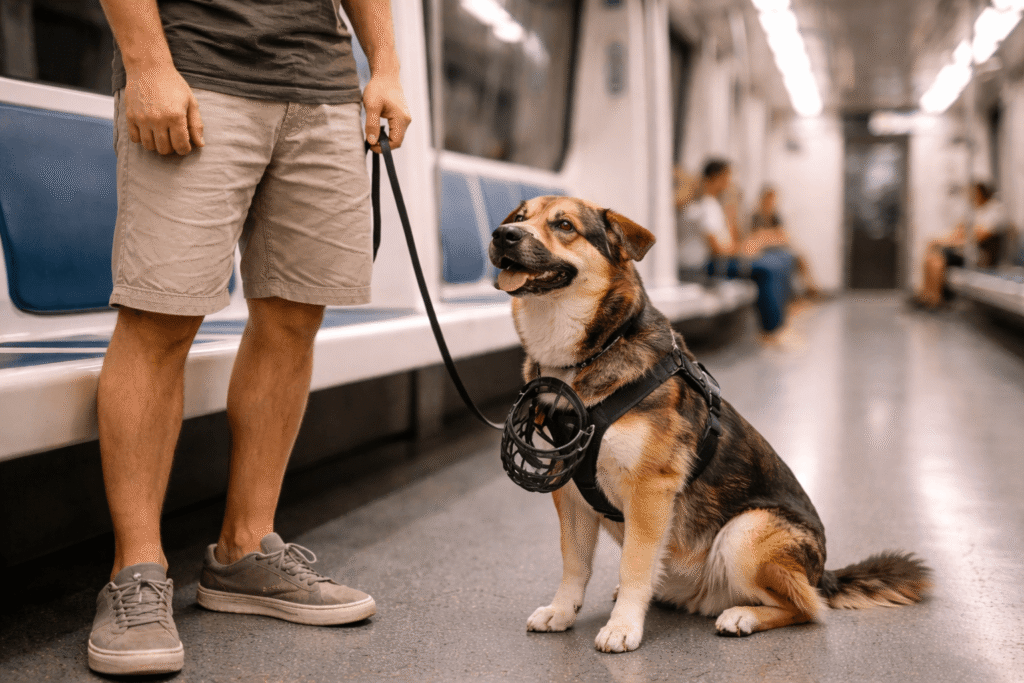
If you are travelling with your dog on the metro in Barcelona, the practical rule is simple: one dog per person, on a non-extendable lead, carrying a muzzle, and kept within 50 cm of the handler from the moment you enter the station until you are back on the street. Only once the muzzle rule was enforced with Chilli, but even being a tiny Yorkie, I always carried it anyway. PDD – Potentially Dangerous Dogs must wear a muzzle whenever in public. 

Dogs may use lifts and fixed stairs, but not escalators. And no, dogs do not get their own seat, no matter how adorable they look.

My local tip is to think beyond “Is it allowed?” and ask “Will this actually feel comfortable for my dog today?” Even when the rules allow it, a noisy station, a hot afternoon, or a packed train can turn a perfectly legal ride into a rather un-pawsome experience – and trust me, the metro in Barcelona, especially during the summer months sometimes can feel like a can-of-sardines-on-fire, not the place I would recommend with a dog, especially the lines that serve the mains attractions and the beaches (green and yellow lines).  

If your dog is nervous, reactive, older, or simply not used to busy urban transport, it may be better to walk part of the route, use a taxi that accepts pets, or plan the outing for a quieter time of day. That is also where planning matters. If your day includes a stop at a non-dog-friendly attraction, check the timing before you leave. If needed, you can book our dog sitting service and keep the day much simpler. It works especially well for places like Sagrada Familia, where dogs are not allowed inside.

Barcelona metro rules for dogs at a glance:

  • Dogs are allowed on the metro only during permitted time slots on weekdays from 11 September to 24 June.
  • On weekends, public holidays, and daily from 24 June to 11 September, dogs can travel at any time.
  • Only one dog is allowed per person.
  • Dogs must carry a muzzle and stay on a non-extendable lead within 50 cm of the handler. 
  • Dogs may use lifts and fixed stairs, but not escalators.
  • Dogs are not allowed on seats.
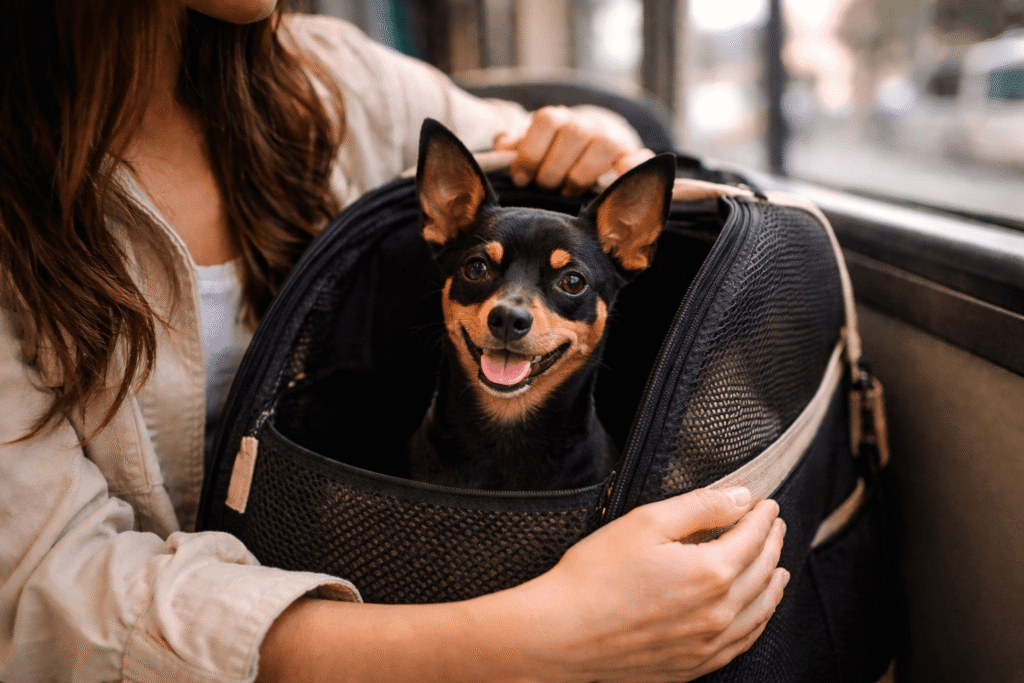
Small dog in a carrier on public transport in Barcelona

Can dogs go on buses in Barcelona?

In most cases, no. Dogs cannot travel on regular Barcelona buses unless they are inside a suitable carrier. TMB allows guide dogs, other assistance dogs, patrol dogs accompanying security staff, and domestic animals carried in specially designed carriers that prevent mess or inconvenience to other passengers.
 
This is the rule that surprises many visitors. They assume that if dogs on public transport in Barcelona are allowed on the metro, the same must apply to buses. It does not. On buses, if your dog is not an assistance dog and is not travelling properly inside a carrier, you should assume the answer is no.
 
For small dogs, that can still work. For medium and large dogs, buses are usually the least practical part of dogs on public transport in Barcelona.
 
With Chilli, this was one of those situations where size definitely helped, and sometimes the driver let me sneak him inside a normal purse, but that was a gamble and not always paid out. I always preferred to think of the bus as a backup plan rather than the easy default. Big-dog parents, I’m afraid, do not get much help from the bus network here.

Barcelona bus rules for dogs at a glance:

  • On Barcelona buses, dogs are not generally allowed on an open lead, even if they are calm or muzzled.
  • TMB allows guide dogs, other assistance dogs identified with the proper tag and blue jacket, and patrol dogs accompanying security staff.
  • Domestic animals can travel on the bus only if they are inside a specially designed carrier that prevents mess or inconvenience to other passengers.
This means the bus network is much more restrictive than the metro for dog owners.
For most travelers with a medium or large dog, the bus is usually not the most practical public transport option in Barcelona. This last point is my practical takeaway based on the official rule above.

Dogs on the tranvia (tram) in Barcelona

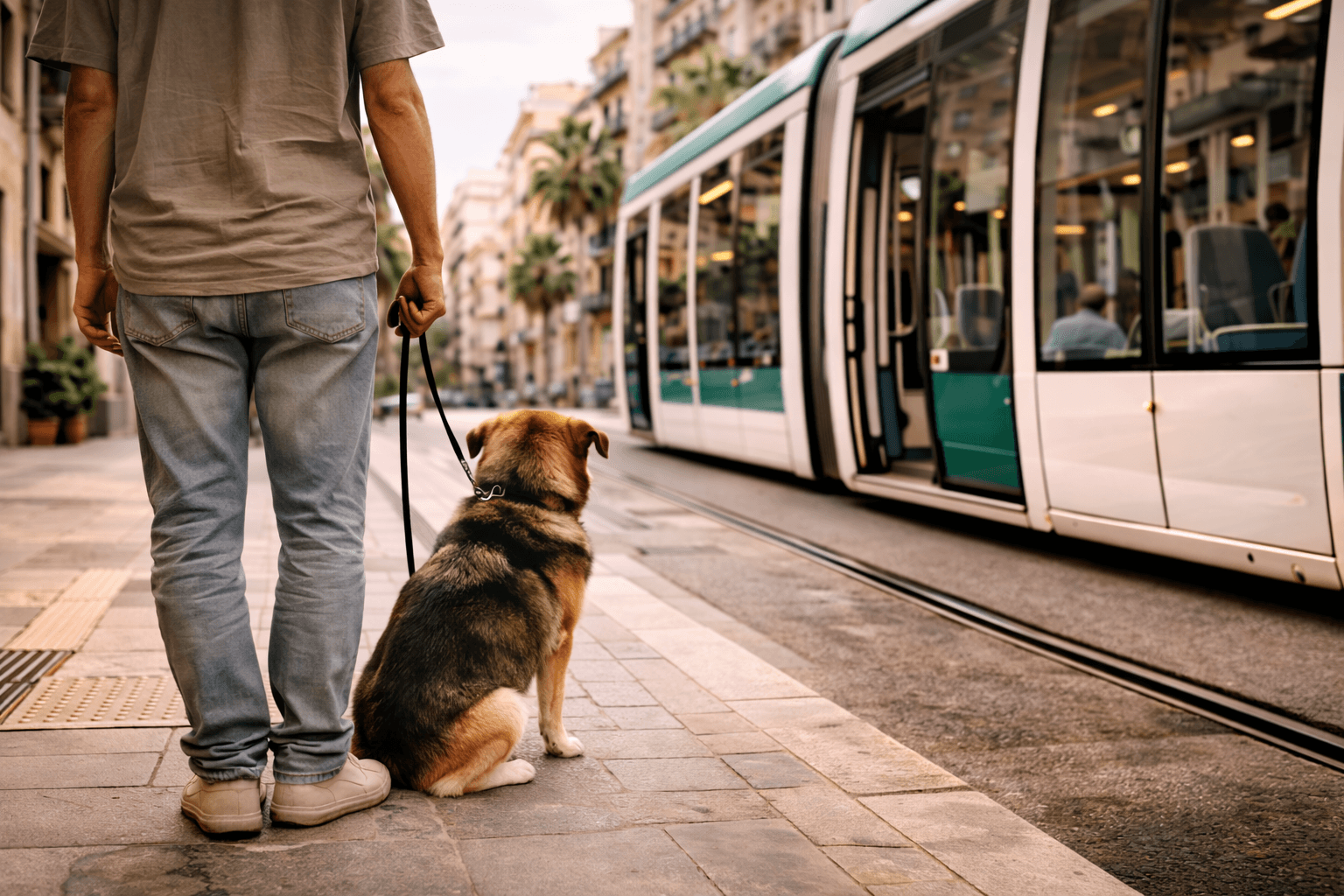
Yes, dogs can travel on Barcelona’s tram network, and in practice, the rules are quite similar to the metro, though you should not assume they are identical just because both feel easy and city-friendly. TRAM allows one dog per person outside peak hours, as long as the dog is wearing a muzzle and is kept on a non-extendable lead no longer than 50 cm from the person handling it.

Between 11 September and 24 June, dogs are not allowed from 7:00 to 9:30 am or from 5:00 to 7:00 pm. On weekends, public holidays, and every day from 24 June to 11 September, they can travel without time restrictions. The person travelling with the dog is responsible for making sure the animal does not disturb other passengers or block doors and passage areas.
 
Honestly, the tram can be one of the nicest parts of dogs on public transport in Barcelona. It feels calmer than the metro. It feels brighter too. If your dog dislikes tunnel noise or crowded underground platforms, the tram often feels much easier. Chilli definitely approved of smoother rides and fewer surprise noises. Tiny commuter. Big standards.
 
My local tip is to think of the tram as a great option for eastern Barcelona routes and quieter connections, especially when you want something more relaxed than the metro but still practical. Just keep an eye on the clock, because the off-peak rule matters here too, and it is much better to plan around it than to discover it with your dog already giving you the “excuse me, mother, what is this chaos?” face. Also, don`t forget to validate your ticket in the machines inside the carriages, otherwise you can get a hefty fine!

Barcelona TRAM rules for dogs at a glance:

  • One dog per person is allowed on the tram.
  • Dogs must wear a muzzle (not usually enforced, but you should have one just in case). 
  • Dogs must stay on a non-extendable lead and within 50 cm of the handler.
  • From 11 September to 24 June, dogs cannot travel between 7:00 and 9:30 am and 5:00 and 7:00 pm.
  • On weekends, public holidays, and from 24 June to 11 September, there are no time restrictions.
  • The handler is responsible for avoiding disruption and keeping doors and passageways clear.
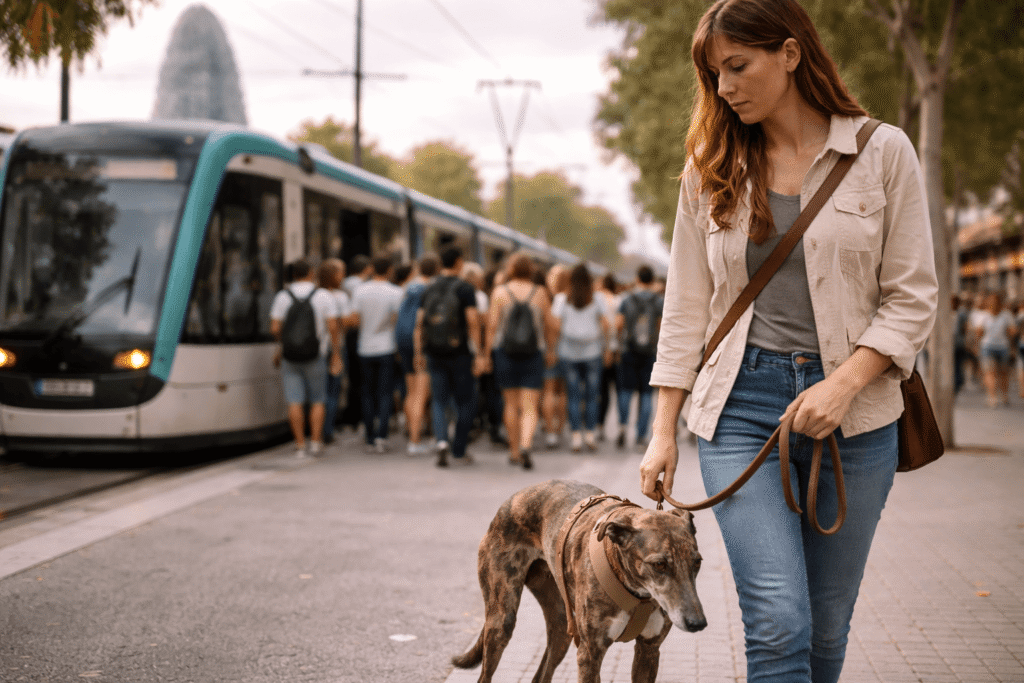
Dog near a Barcelona tram during a busy public transport moment

FGC and Rodalies trains: commuter rail options with a dog

If you need to move beyond the very centre of Barcelona, FGC and Rodalies are usually much more useful for dog owners than the bus network. Both systems allow dogs under specific conditions, which makes them a very practical option for day plans, outer neighborhoods, and some easy escapes beyond the city. That said, each operator has its own rules, so this is not one of those “one leash fits all” situations. The official conditions are similar in spirit, but not identical in detail.

Dogs on FGC trains

FGC trains allow pets to travel free of charge, as long as train occupancy does not require that access to be limited. Dogs must wear a muzzle and be kept on a lead from the moment they enter FGC facilities. Small animals must travel in baskets or cages and may not occupy a seat. FGC also states that no more than one dog per person is allowed, and potentially dangerous dogs may not be handled by anyone under 16 years old. Assistance dogs are treated differently and are not subject to occupancy restrictions.
 
In real life, FGC can be a very handy option if you are staying in areas connected to its lines or heading somewhere that feels awkward by metro alone. My practical takeaway is that it tends to work best when you travel outside the busiest moments and keep your dog close, calm, and very much in “civilised commuter” mode.

Dogs on Rodalies Renfe trains

Rodalies Renfe also allows dogs, but the wording is a little messier depending on which official page you read, so this is one of those areas where I would always recheck before travelling. The general rule is that dogs must wear a muzzle and collar and be kept on a lead from the moment they enter railway premises. Small animals must travel in baskets or cages and cannot occupy a seat. Potentially dangerous dogs may not be handled by children under 16, and the lead must be non-extendable and no longer than two metres. Only one animal per passenger is allowed.
 
Fares are the one area where Rodalies can be a little less straightforward. Small pets generally travel free on suburban services, while some regional services may apply an extra charge for dogs. The practical takeaway is simple: check the fare conditions for your specific route before you travel. It is a small step, but a very worthwhile one if you would rather avoid an unexpected plot twist at the station.
 
For visitors, the big takeaway is simple: FGC and Rodalies are far more realistic than the bus if you are travelling across Barcelona or out toward nearby areas with your dog. They are not fully friction-free, but they are workable, and that already makes them rather heroic by urban transport standards.
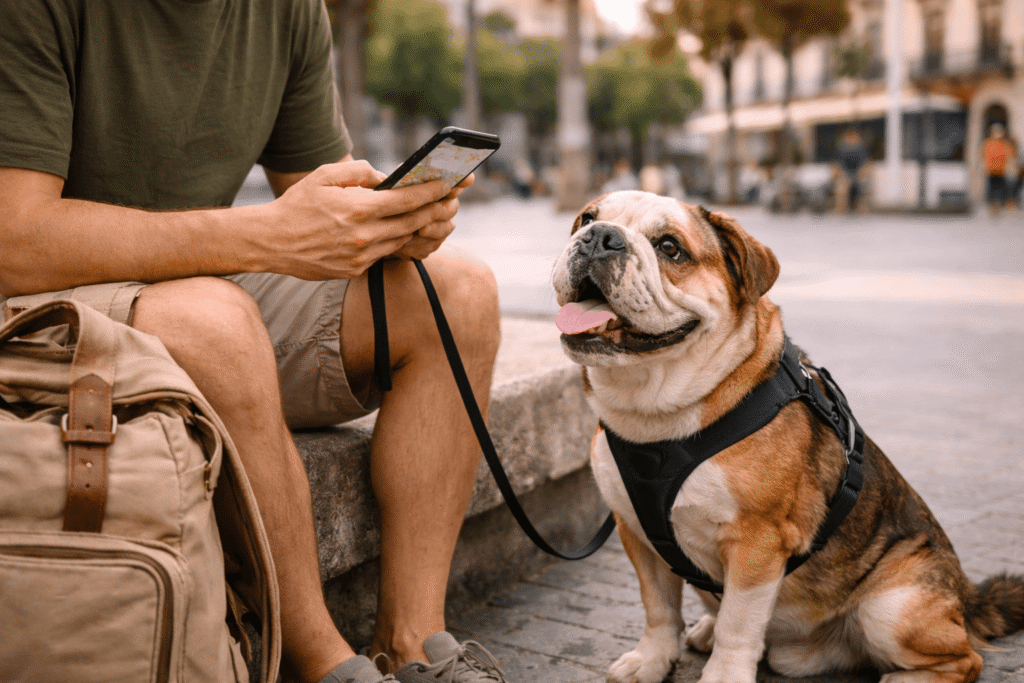
Traveler planning dogs on public transport in Barcelona with a dog beside him

Long-distance trains to and from Barcelona with a dog

Long-distance train travel to and from Barcelona is possible with a dog, but it depends much more on the type of Renfe service than on the city itself. In practice, the easiest option is usually travelling with a small pet of up to 10 kg inside a carrier on eligible AVE, AVE International and other Long Distance trains, following Renfe’s pet conditions.
 
Renfe states that small pets can travel on AVE, AVE International between Spain and France, and Long Distance trains if they weigh no more than 10 kg and travel inside a carrier with maximum dimensions of 60 x 35 x 35 cm. On Avlo, the rule is also limited to small pets up to 10 kg in a carrier, with one pet per person, and the pet must travel with its own ticket.
 
There is also a very useful option for some bigger dogs: Renfe says you can travel with one dog of up to 40 kg without a carrier on certain trains that have allocated seats for dogs, using the corresponding add-on. This is excellent news for people travelling with medium or large dogs, but it is train-specific, so it should always be checked for the exact route and service before booking.
 
For travelers coming to Barcelona, the practical takeaway is simple: long-distance train travel with a dog is possible, but it is not one single rule across all Renfe services. Small dogs in carriers are the most straightforward case. Bigger dogs may also be able to travel, but only on selected services with designated places for them. That extra check before booking is absolutely worth it, especially if you would rather not discover a transport limitation with luggage in one hand and an unimpressed dog in the other.
 
With Chilli, train travel always felt much more manageable when I treated it as a plan, not an impromptu decision. That is really the secret here: choose the right train first, then plan the rest of the journey around it. Tiny dogs may get the easier setup, but even they do not get to freestyle the Renfe rulebook.

Long-distance train rules at a glance

  • Small pets of up to 10 kg can travel on eligible AVE, AVE International and Long Distance trains if they are inside a carrier.
  • On Avlo, pets must also weigh no more than 10 kg, travel in a carrier, and have their own pet ticket.
  • Renfe also offers an option to travel with dogs up to 40 kg without a carrier on selected trains with allocated dog seats.
  • Availability for larger dogs depends on the specific train, so it should be checked case by case before booking.

Moving around Barcelona public transport with your dog, resumed:
My local advice is simple: if you are travelling with a dog in Barcelona, plan around the metro, tram or rail options first, and only consider the bus if your dog is small enough to ride comfortably in a carrier. It saves confusion, awkward conversations, and that classic travel moment where you are standing at the stop trying to look optimistic while your dog is very clearly not foldable. The official TMB rules also state that only animals in specially designed carriers are allowed on buses, alongside guide, assistance and patrol dogs.
Dogs on Public Transport in Barcelona: Metro, Bus, Tram & Train Rules
Did you find this post useful? Save it, Pin it, Share it!

Practical tips before you board with your dog
Barcelona can be surprisingly workable with a dog on public transport, but the smoothest trips usually come down to one thing: planning for the specific operator, not just the route. Metro, bus, tram, FGC, Rodalies and long-distance Renfe services do not all follow the same dog rules, even when they are part of the same wider transport system. That means the smart move is to check the conditions for the exact service you plan to use before heading out.
 
One of the best local habits is to avoid busy times whenever possible. On the metro, dogs are only allowed during specific weekday time windows outside the main rush hours, and TMB can also restrict access when trains or stations are too crowded. TRAM also limits dog access during weekday peak times, and FGC states that pets may travel free as long as train occupancy does not alter that condition. In real life, even when a trip is technically allowed, it is usually much more comfortable for both you and your dog if you travel at calmer times.
 
It is also worth getting the basic gear right before you leave. For metro, tram, FGC and Rodalies, dogs generally need to travel on a non-extendable lead and, sometimes, wearing a muzzle. On buses, domestic animals must travel in a specially designed carrier, unless they are guide, assistance or patrol dogs. For many long-distance Renfe services, small pets must also travel in a carrier, and Renfe sets specific size and weight conditions depending on the service.
 
For the Barcelona metro in particular, one detail really matters: do not use escalators with your dog. TMB specifically advises using stairs or lifts instead, and dogs are not allowed on seats. It is a small detail, but a very important one for safety.
 
My practical advice is to think beyond “Is this allowed?” and ask “Will this be comfortable for my dog today?” A nervous dog, an older dog, a reactive dog, or simply a dog having a very dramatic main-character moment may not enjoy a packed station or a noisy train, even if the rules technically allow the trip.
 
Barcelona public transport can work very well with dogs, but the best journeys tend to happen when the route, the time of day and the dog’s personality all line up nicely. The law may allow the ride, but your dog still gets a vote.

Quick checklist before taking public transportation in Barcelona with a dog:

  • Check the rules for the specific operator you are using.
  • Travel outside busy times whenever possible.
  • Bring a non-extendable lead, and a muzzle where required.
  • Use a carrier if the service requires one, especially on buses and many long-distance train services.
  • On the metro, use stairs or lifts, not escalators.
  • Choose the route based on your dog’s comfort, not just what is technically permitted.

When public transport is not the best option

Yes, traveling with your dog on public transport in Barcelona can be a lifesaving travel hack, but it is not always the right choice for every route, every dog, or every moment. Metro and tram access comes with time restrictions and handling rules, buses are far more limited, and train conditions vary by operator and service. In other words, public transport is useful, but it is not automatically the best plan just because it exists.

If your dog is nervous, reactive, elderly, recovering from an injury, not used to crowds, or simply overwhelmed by noise and movement, a packed station or busy carriage may be more stress than it is worth. Even when a trip is technically allowed, that does not always mean it will feel comfortable or safe for your dog. In real life, this is where common sense matters more than trying to win a debate with the rulebook.
 

Taking Public transportation in Barcelona with a dog may also be the wrong fit when your route depends heavily on buses, since regular Barcelona buses only allow guide dogs, assistance dogs, patrol dogs, and domestic animals inside a suitable carrier. For many travelers with a medium or large dog, this makes the bus network the least practical option in the city.

This is also where Wander Woofs can make the day much easier. If you are planning to use public transport as part of a sightseeing day and one of your stops does not allow dogs inside, we can help with both sides of the plan: practical pet-friendly travel organisation and on-site dog-sitting nearby while you visit the attraction. That way, you do not have to rely on a complicated transport chain, leave your dog alone at the hotel, or miss one of Barcelona’s big highlights.

Short FAQ: Are Dogs Allowed on Public Transport in Barcelona?

Are dogs allowed on public transport in Barcelona?
Yes, but the rules depend on the operator. Metro, tram, FGC and some train services allow dogs under specific conditions, while buses are much more restrictive.

Can dogs go on the Barcelona metro?
Yes. Dogs can travel on the metro during specific weekday time windows and without time restrictions on weekends, public holidays, and during the summer period set by TMB. They must wear a muzzle and stay on a short, non-extendable lead.

Can dogs go on buses in Barcelona?
Usually only if they travel inside a suitable carrier. Guide dogs, other assistance dogs, and patrol dogs are also allowed.

Do dogs need a muzzle on public transport in Barcelona?
In many cases, yes. Metro, tram, FGC and Rodalies generally require the dog to have a muzzle for dogs travelling outside a carrier, but many times, wearing it is not enforced. We recommend having it and putting it on if your dog is a PPP or if asked. Only once was Chilli actually required to wear a muzzle, but to be fair, his muzzle was the size of a sewing thimble! 

Can dogs travel on long-distance trains to and from Barcelona?
Yes, but it depends on the Renfe service. Small pets can usually travel in a carrier on eligible trains. Some larger dogs can also travel on selected services with designated dog spaces.

What if my Barcelona attraction does not allow dogs inside?
That is where Wander Woofs can help. We support travelers with pet-friendly travel planning and on-site dog-sitting nearby while they visit attractions that do not allow dogs inside.

Final thoughts on using public transportation with a dog in Barcelona

Dogs on public transport in Barcelona are absolutely manageable once you know the rules, the best options, and the small local details that make all the difference. With a bit of planning, Barcelona can be a very easy city to explore with your dog. And if one of your plans takes you somewhere dogs are not allowed inside, Wander Woofs can help make the day smoother with pet-friendly travel planning and on-site dog-sitting, so you can explore stress-free and your pup can stay happy, safe, and very much included in the adventure.